


Introduction to Foreign Business Setup in Nepal
Nepal has progressively opened its economy to foreign investors over the past two decades. The government of Nepal has introduced structured frameworks that allow foreign nationals and companies to establish businesses in Nepal under defined legal conditions. The term Foreign Entrepreneur Setup Package in Nepal refers to the complete bundle of legal procedures, documentation requirements, regulatory approvals, investment thresholds, and compliance obligations that a foreign investor must fulfill to legally operate a business in Nepal.
Foreign direct investment (FDI) in Nepal is governed primarily by the Foreign Investment and Technology Transfer Act, 2019 (FITTA 2019), which replaced the earlier FITTA 1992. This law provides the foundational structure for all foreign business operations in Nepal. Additionally, the Companies Act 2006, Industrial Enterprises Act 2020, and Special Economic Zone Act 2016 play significant roles in defining the operating environment for foreign entrepreneurs.
Nepal’s Department of Industry (DOI) and the Investment Board Nepal (IBN) are the two primary government agencies managing foreign investment approvals, depending on the size and nature of the investment.
What Is a Foreign Entrepreneur Setup Package in Nepal?
A Foreign Entrepreneur Setup Package is not a single product offered by the Nepal government. It is a collective term used by business consultants, legal firms, and company registration agents in Nepal to describe the end-to-end process of setting up a foreign-owned or foreign-invested business in Nepal. This package typically covers:
- Foreign investment approval from DOI or IBN
- Company incorporation under the Office of the Company Registrar (OCR)
- Tax registration at the Inland Revenue Department (IRD)
- Industry registration or business license
- Work permit and visa processing for foreign personnel
- Bank account opening and capital remittance procedures
- Ongoing compliance and annual filing services
The package simplifies a multi-agency process into a single service offering, making it easier for international entrepreneurs to enter the Nepali market.
Legal Framework Governing Foreign Business in Nepal
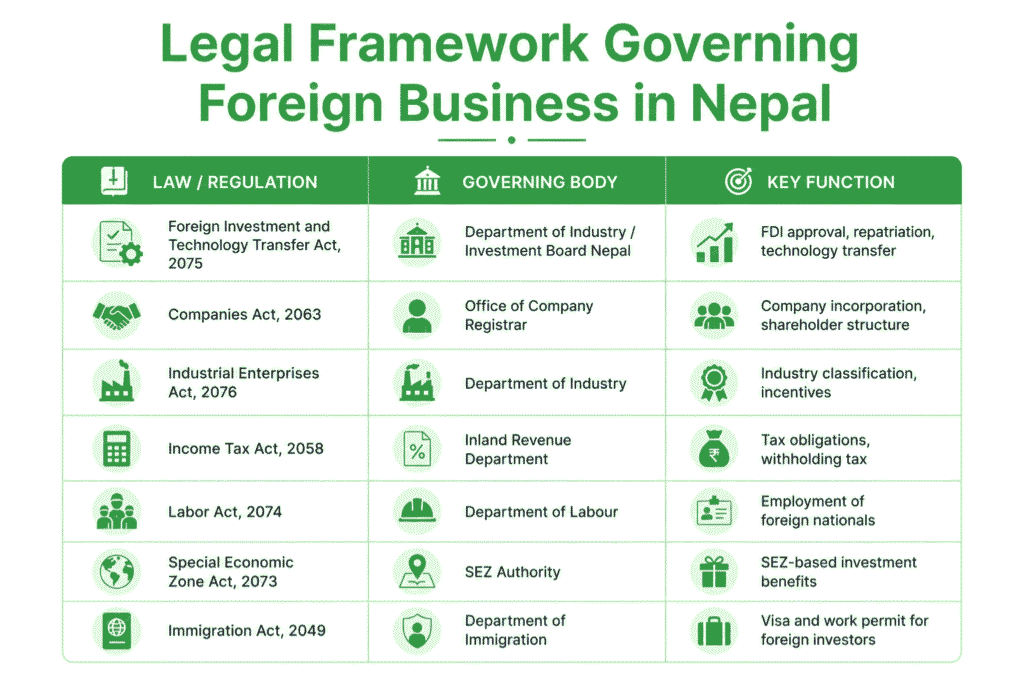
Understanding the legal structure is the first step before exploring any setup package. Several key laws regulate the rights and obligations of foreign entrepreneurs:
| Law / Regulation | Governing Body | Key Function |
|---|---|---|
| Foreign Investment and Technology Transfer Act, 2075 | Department of Industry / Investment Board Nepal | FDI approval, repatriation, technology transfer |
| Companies Act, 2063 | Office of Company Registrar | Company incorporation, shareholder structure |
| Industrial Enterprises Act, 2076 | Department of Industry | Industry classification, incentives |
| Income Tax Act, 2058 | Inland Revenue Department | Tax obligations, withholding tax |
| Labor Act, 2074 | Department of Labour | Employment of foreign nationals |
| Special Economic Zone Act, 2073 | SEZ Authority | SEZ-based investment benefits |
| Immigration Act, 2049 | Department of Immigration | Visa and work permit for foreign investors |
Foreign entrepreneurs must comply with all these laws simultaneously. Failure to comply with even one framework can result in penalties, license revocation, or deportation in the case of individual foreign nationals.
Eligible Business Structures for Foreign Investors in Nepal
Foreign investors in Nepal can choose from several types of business structures. Each structure has specific ownership rules, liability implications, and registration processes.
1. Private Limited Company (Pvt. Ltd.)
This is the most common structure used by foreign investors in Nepal. Under the Companies Act 2006, a private limited company can have foreign shareholders. Foreign ownership can be up to 100% in most sectors, subject to sector-specific restrictions under FITTA 2019.
2. Public Limited Company
A public limited company can also receive foreign investment. It is suitable for larger enterprises that may eventually list on the Nepal Stock Exchange (NEPSE).
3. Branch Office
Foreign companies can register a branch office in Nepal. A branch office must obtain approval from the OCR and the DOI. Branch offices are taxed on profits generated in Nepal.
4. Liaison Office / Representative Office
A liaison office is a non-commercial presence. It cannot earn revenue but can manage marketing, research, and coordination activities. This requires approval from the DOI.
5. Joint Venture Company
Foreign investors can enter into a joint venture with a Nepali partner. The foreign ownership percentage depends on the sector and the agreement between parties.
Minimum Foreign Investment Requirements in Nepal
Under FITTA 2019, there is a minimum foreign investment threshold that must be met for a business to qualify as a foreign-invested enterprise and receive associated benefits.
| Investment Category | Minimum Investment Requirement |
|---|---|
| General Foreign Investment | NPR 20 million (approx. USD 150,000) |
| Technology Transfer Agreement | No minimum threshold; negotiated basis |
| Investment Board Nepal (IBN) jurisdiction | NPR 6 billion or more |
| Special Economic Zone (SEZ) investment | NPR 10 million |
Investments below the minimum threshold do not qualify for foreign investment approvals under FITTA 2019. The government reviews these thresholds periodically, and investors should verify current figures directly with the Department of Industry Nepal.
Step-by-Step Process for Foreign Entrepreneur Business Registration in Nepal
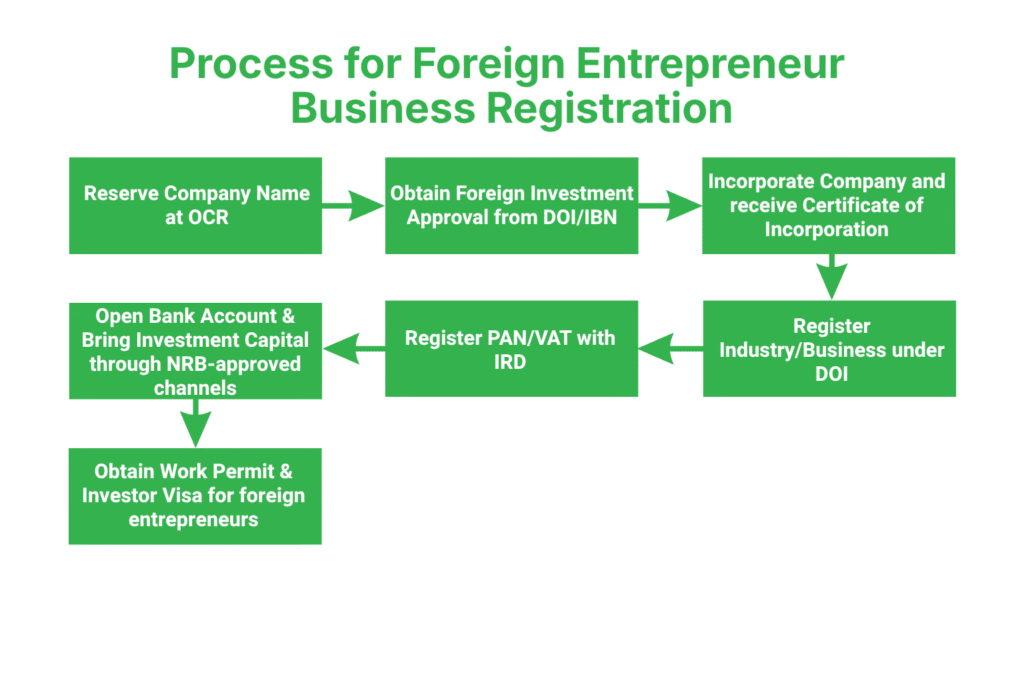
The process of registering a foreign-invested company in Nepal involves multiple agencies. Below is the standard process for establishing a private limited company with foreign investment:
Step 1: Name Reservation at OCR
- Submit a name reservation application to the Office of the Company Registrar (OCR)
- Provide up to three preferred company names
- Name approval typically takes 1–3 working days
Step 2: Foreign Investment Approval from DOI
- Submit a foreign investment proposal to the Department of Industry
- Required for investments below NPR 6 billion
- Investment Board Nepal handles larger investments
- Approval timeline: 7–15 working days under FITTA 2019
Step 3: Company Incorporation at OCR
- File the Memorandum of Association (MoA) and Articles of Association (AoA)
- Submit shareholder identification documents
- Pay prescribed registration fees based on authorized capital
- Receive the Certificate of Incorporation
Step 4: Industry/Business Registration at DOI
- Register the company as an industry under the Industrial Enterprises Act 2020
- Obtain the Industry Registration Certificate
Step 5: Permanent Account Number (PAN) Registration
- Register at the Inland Revenue Department (IRD)
- Obtain a PAN/VAT registration certificate if applicable
- VAT registration is mandatory if annual turnover exceeds NPR 5 million
Step 6: Capital Inflow and Bank Account Opening
- Open a corporate bank account in Nepal
- Remit foreign investment capital through banking channels
- Obtain a foreign currency inflow verification certificate from the Nepal Rastra Bank (NRB)
Step 7: Work Permit and Business Visa
- Apply for a work permit at the Department of Labour, Employment and Training
- Apply for a Business Visa or Investor Visa at the Department of Immigration Nepal
- Business visa is valid for one year and is renewable
Documents Required for Foreign Entrepreneur Setup in Nepal
For Foreign Individual Investors:
- Valid passport copies (notarized)
- Recent passport-size photographs
- Personal bank statement (last 6 months)
- Tax clearance certificate from country of origin
- No objection letter from the home country (if applicable)
- CV or business profile
For Foreign Corporate Investors:
- Certificate of Incorporation of the foreign company
- Memorandum and Articles of Association of the foreign company
- Board resolution authorizing investment in Nepal
- Audited financial statements (last 2 years)
- Power of Attorney in favor of the local representative
- Company bank reference letter
For Both (Nepal-Specific Documents):
- Proposed company name reservation approval
- Draft MoA and AoA in Nepali language
- Office lease agreement in Nepal
- Nepali citizen co-director’s citizenship certificate (if applicable)
All foreign documents must be apostilled or notarized and legalized by the concerned Nepali Embassy or Consulate in the country of origin.
Restricted and Prohibited Sectors for Foreign Investment
FITTA 2019 lists sectors where foreign investment is either prohibited or requires special government approval. Foreign entrepreneurs must review these restrictions before finalizing their business plan.
Prohibited Sectors for Foreign Investment:
- Cottage and small industries
- Arms and ammunition manufacturing
- Currency printing
- Real estate (for non-residents)
- Retail trading below USD 1 million investment
- Travel agencies (below threshold)
- Mass media and publication (with restrictions)
Restricted Sectors (Require Special Approval):
- Banking and financial services
- Insurance
- Telecommunications
- Hydropower above threshold
- Education and health institutions
The full list of restricted and prohibited sectors is available at the Investment Board Nepal website.
Tax Incentives and Benefits for Foreign Investors in Nepal
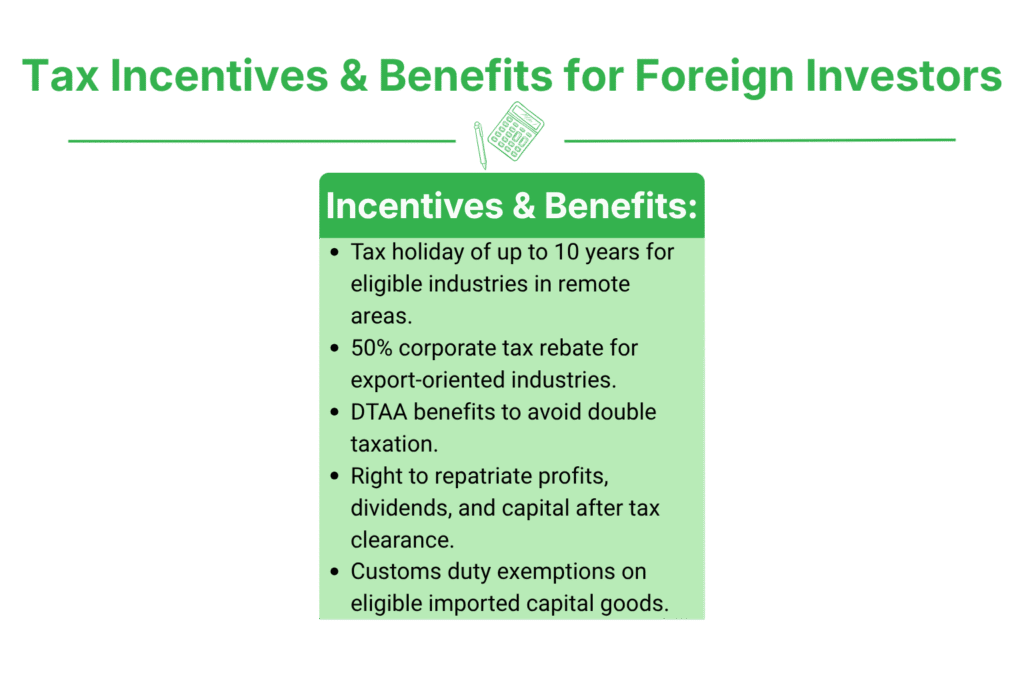
Nepal’s Industrial Enterprises Act 2020 provides several tax incentives to attract foreign entrepreneurs:
- Tax Holiday: Special industries in remote areas can receive up to 10 years of income tax exemption.
- Reduced Corporate Tax Rate: Export-oriented industries enjoy a 50% rebate on corporate income tax.
- Double Taxation Avoidance Agreements (DTAA): Nepal has signed DTAAs with multiple countries including India, China, Norway, Thailand, and others to prevent double taxation.
- Repatriation of Profits: FITTA 2019 guarantees the right to repatriate profits, dividends, and invested capital after tax clearance.
- Customs Duty Exemption: Capital goods imported for specific industries may qualify for customs duty exemptions.
Cost of Foreign Entrepreneur Setup Package in Nepal
The cost of a complete foreign entrepreneur setup package in Nepal varies based on the service provider and the complexity of the business structure. General costs include:
- Government Fees: Registration fees at OCR range from NPR 9,000 to NPR 50,000 depending on authorized capital.
- DOI Approval Fees: Minimal government fee plus professional service charges.
- Consultant/Legal Fees: Professional packages from law firms or business consultants typically range from NPR 50,000 to NPR 300,000 or more.
- Work Permit Fees: NPR 5,000 per month per foreign worker (payable to Department of Labour).
- Business Visa Fees: USD 40 per month for multiple-entry business visa.
FAQs
1. Can a foreign national own 100% of a company in Nepal?
Yes. Under FITTA 2019, foreign nationals can own 100% equity in a Nepali company in most eligible sectors. However, certain restricted and prohibited sectors require Nepali partnership or are entirely closed to foreign ownership.
2. What is the minimum investment required to start a business in Nepal as a foreigner?
The minimum foreign investment threshold under FITTA 2019 is NPR 20 million (approximately USD 150,000) for most sectors. SEZ investments require a lower threshold of NPR 10 million.
3. How long does the foreign company registration process take in Nepal?
The complete foreign company registration process in Nepal typically takes 30 to 60 working days. The timeline depends on document preparation, government approval queues, and sector-specific clearances.
4. Is a local Nepali partner required to register a foreign company in Nepal?
No, a local Nepali partner is not legally required for most sectors under FITTA 2019. A fully foreign-owned private limited company is allowed. However, having a local director simplifies many administrative processes.
5. Can a foreign investor repatriate profits from Nepal?
Yes. FITTA 2019 explicitly guarantees the right to repatriate profits, dividends, royalties, and principal investment after payment of applicable taxes and obtaining clearance from the Inland Revenue Department and Nepal Rastra Bank.
6. What visa does a foreign investor need to operate a business in Nepal?
A foreign investor needs a Business Visa or Non-Tourist Visa issued by the Department of Immigration Nepal. A work permit from the Department of Labour is also required for foreign individuals actively working within the company.
Conclusion
The Foreign Entrepreneur Setup Package in Nepal encompasses a multi-step, multi-agency process governed by FITTA 2019, the Companies Act 2006, and the Industrial Enterprises Act 2020. Foreign investors must secure DOI or IBN approval, incorporate at OCR, register for taxes at IRD, and comply with labour and immigration laws. Nepal offers competitive tax incentives, profit repatriation rights, and a growing economy that presents genuine opportunities for foreign entrepreneurs willing to invest within the defined legal framework.
For official information, visit: