

Nepal has opened its doors to foreign investors across multiple sectors. The government has introduced streamlined policies, a one-stop service center, and updated legislation to attract foreign direct investment (FDI). If you are planning to start a business in Nepal as a foreigner, understanding the legal framework, registration process, investment thresholds, and sector restrictions is the first step.
Can a Foreigner Start a Business in Nepal?
Yes, a foreigner can start a business in Nepal. The Government of Nepal permits foreign nationals and foreign entities to invest in Nepal under specific legal provisions. The primary law governing foreign investment in Nepal is the Foreign Investment and Technology Transfer Act, 2019 (FITTA 2075 BS). This act replaced the earlier FITTA of 1992 and brought significant reforms to simplify foreign business registration in Nepal.
Under FITTA 2019, foreign investment in Nepal is allowed in the following forms:
- Equity investment in a Nepali company
- Reinvestment of earnings derived from foreign investment
- Investment through loans from foreign sources
- Technology transfer agreements
Foreign investors can either establish a wholly foreign-owned company or enter into a joint venture with a Nepali partner. Both structures are legally recognized under the Companies Act, 2006 (2063 BS).
What Laws Govern Foreign Business in Nepal?
Several key laws regulate foreign investment and business registration in Nepal:
| Law | Year | Purpose |
|---|---|---|
| Foreign Investment and Technology Transfer Act, 2075 | 2019 (2075 BS) | Governs foreign investment entry, approval, and repatriation |
| Companies Act, 2063 | 2006 (2063 BS) | Governs company incorporation and operation |
| Industrial Enterprises Act, 2076 | 2020 (2076 BS) | Regulates industrial licensing and operations |
| Special Economic Zone Act, 2073 | 2016 (2073 BS) | Governs investment in SEZ areas |
| Income Tax Act, 2058 | 2002 (2058 BS) | Governs taxation of businesses |
| Labor Act, 2074 | 2017 (2074 BS) | Governs employment including foreign workers |
The Investment Board Nepal (IBN) handles large-scale foreign investments above NPR 6 billion, while the Department of Industry (DOI) under the Ministry of Industry, Commerce and Supplies manages smaller foreign investments. You can visit the Department of Industry Nepal and Investment Board Nepal for official information.
What Is the Minimum Investment Requirement for Foreigners in Nepal?
One of the most common questions foreigners ask before starting a business in Nepal is about the minimum investment threshold.
Under FITTA 2019 and the Industrial Enterprises Act 2020, the minimum foreign investment requirement is:
- NPR 50 million (approximately USD 375,000) for foreign investors in most sectors.
This threshold was raised significantly from the earlier NPR 5 million limit under the old FITTA. The intention was to attract quality, large-scale investment rather than small token investments.
However, there are some exceptions for:
- Technology-based industries and startups where the minimum may be relaxed under specific government directives.
- Special Economic Zones (SEZ) where separate thresholds and incentives apply.
- Joint ventures with Nepali partners, where the equity share of the foreign investor must still meet the minimum threshold.
Foreigners should verify the current threshold with the Department of Industry or a registered legal advisor in Nepal before proceeding.
Which Sectors Are Open to Foreign Investment in Nepal?
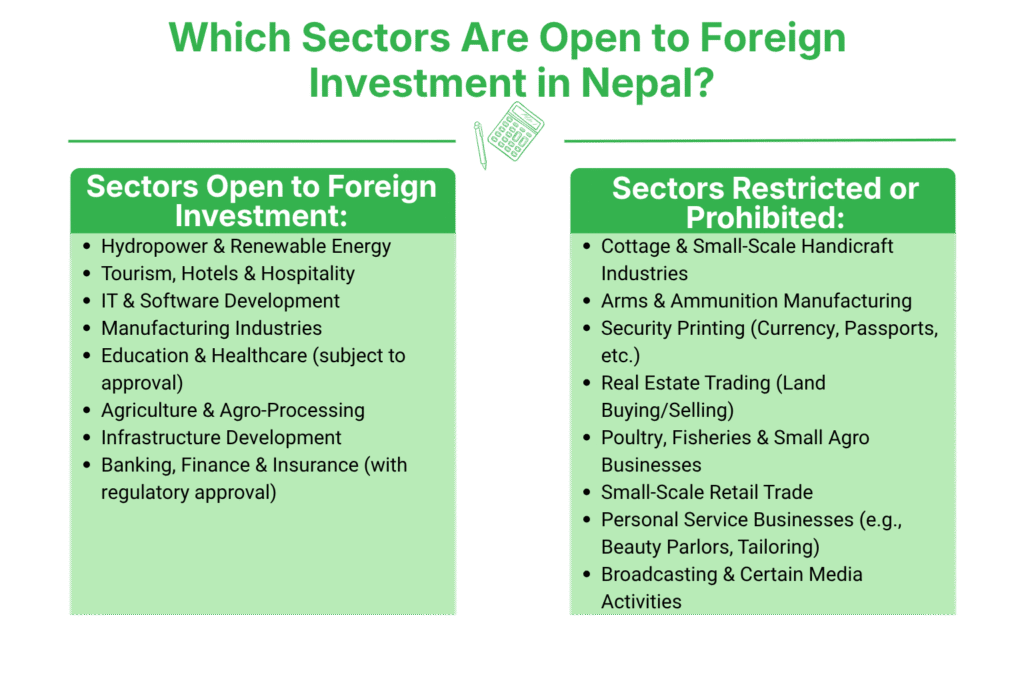
Nepal follows a negative list approach under FITTA 2019. This means all sectors are open to foreign investment except those explicitly prohibited or restricted.
Sectors Open for Foreign Investment include:
- Hydropower and renewable energy
- Tourism, hotels, and hospitality
- Information technology and software development
- Manufacturing and production industries
- Education and healthcare (with conditions)
- Agriculture and agro-processing
- Infrastructure development
- Banking, finance, and insurance (with regulatory approval)
Sectors Restricted or Prohibited for Foreign Investment:
- Cottage industries and small-scale handicraft businesses (reserved for Nepali citizens)
- Arms and ammunition manufacturing
- Security printing (currency, passports)
- Real estate business (buying and selling land)
- Poultry farming, fisheries, and similar small agro businesses
- Retail trade (individual or small business retail)
- Personal service businesses such as beauty parlors, tailoring below a certain scale
- Mass communication and media (broadcasting)
The full list of restricted sectors is published by the Government of Nepal through the Ministry of Industry, Commerce and Supplies. Foreigners must review the Negative List of FITTA 2019 before choosing their business sector.
What Type of Company Can a Foreigner Register in Nepal?
A foreigner can register the following types of business entities in Nepal:
1. Private Limited Company (Pvt. Ltd.)
This is the most common structure for foreign investors in Nepal. A private limited company requires a minimum of one director and one shareholder. Foreigners can own up to 100% equity in sectors open to full foreign ownership.
2. Public Limited Company
This structure is suitable for large-scale businesses planning to list shares on the Nepal Stock Exchange (NEPSE) or raise public capital.
3. Branch Office or Liaison Office
Foreign companies already operational abroad can establish a branch office in Nepal. However, branch offices have limited operational scope and require separate approval from the Department of Industry.
4. Joint Venture Company
A joint venture between a foreign investor and a Nepali citizen or entity is another popular business structure. This structure benefits from the local partner’s knowledge and may have access to sectors with partial restrictions.
What Is the Step-by-Step Process to Start a Business in Nepal as a Foreigner?
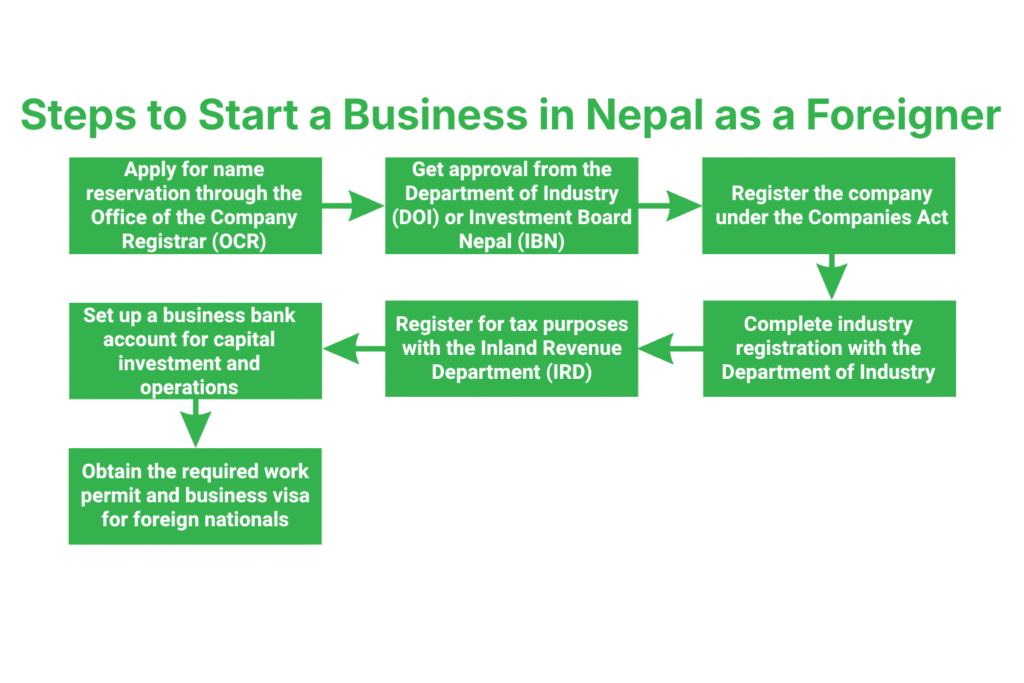
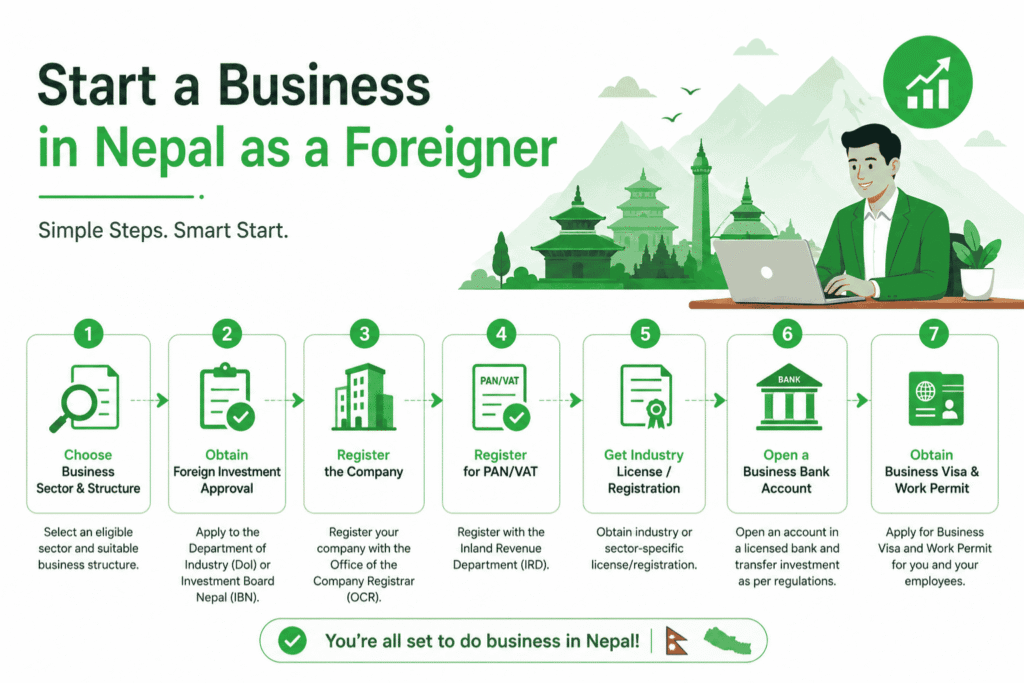
The business registration process for foreigners in Nepal involves multiple government agencies. Nepal has established a One Stop Service Center (OSSC) at the Department of Industry to streamline this process.
Step 1: Name Reservation Register and reserve your company name through the Office of the Company Registrar (OCR) at ocr.gov.np.
Step 2: Apply for Foreign Investment Approval Submit a foreign investment application to the Department of Industry or the Investment Board Nepal depending on the investment size. Fill out the prescribed form along with supporting documents.
Step 3: Company Incorporation After receiving foreign investment approval, register the company with the Office of the Company Registrar under the Companies Act 2006.
Step 4: Industry Registration Register the industry or enterprise with the Department of Industry under the Industrial Enterprises Act 2020.
Step 5: Tax Registration (PAN/VAT) Obtain a Permanent Account Number (PAN) and, if applicable, Value Added Tax (VAT) registration from the Inland Revenue Department (IRD) at ird.gov.np.
Step 6: Bank Account Opening Open a corporate bank account in a licensed Nepali bank for capital remittance and operational transactions.
Step 7: Work Permit and Business Visa Foreign nationals working in Nepal must obtain a work permit from the Department of Labor and Employment and a business visa from the Department of Immigration Nepal at immigration.gov.np.
What Documents Are Required to Start a Business in Nepal as a Foreigner?
The following documents are generally required for foreign business registration in Nepal:
For Individual Foreign Investor:
- Valid passport copy (notarized)
- Passport-size photographs
- Residential proof or address verification from home country
- Bank statement showing financial capacity
- Investment proposal or business plan
For Foreign Company Investor:
- Certificate of Incorporation of the foreign company (notarized and apostilled)
- Memorandum and Articles of Association
- Board resolution authorizing investment in Nepal
- Audited financial statements
- Details of directors and shareholders
- Power of attorney if represented by an agent in Nepal
For Both:
- Proposed company name (minimum three options)
- Draft Memorandum of Association and Articles of Association
- Proposed shareholding structure
- Project report or feasibility study
What Are the Tax Obligations for Foreign Businesses in Nepal?
Foreign-owned businesses in Nepal are subject to the same tax framework as domestic companies under the Income Tax Act 2002 (2058 BS).
| Tax Type | Rate | Authority |
|---|---|---|
| Corporate Income Tax | 25% (standard) | Inland Revenue Department |
| Special Industry Rate | 20% | Inland Revenue Department |
| Dividend Tax | 5% on profit repatriation | Inland Revenue Department |
| Value Added Tax (VAT) | 13% | Inland Revenue Department |
| Capital Gains Tax | Applicable on asset sale | Inland Revenue Department |
| Withholding Tax | 15% (non-residents) | Inland Revenue Department |
Nepal also has Double Taxation Avoidance Agreements (DTAA) with several countries including India, China, and others. Foreign investors from these countries can benefit from reduced tax rates.
Foreign investors are entitled to repatriate dividends, profits, and proceeds from the sale of shares or assets after paying applicable taxes, as provided under FITTA 2019 Section 9.
Does a Foreign Investor Need a Visa to Do Business in Nepal?
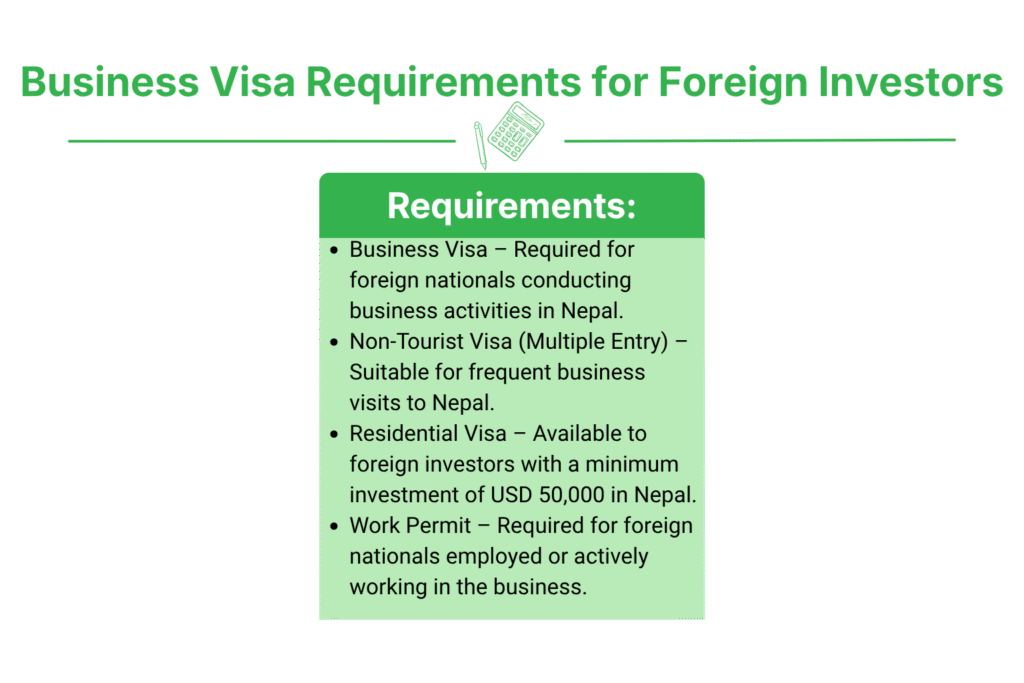
Yes. A foreign national conducting business in Nepal requires an appropriate visa. Nepal’s Department of Immigration issues the following relevant visa types:
- Business Visa: For foreign nationals engaged in business activities in Nepal
- Non-Tourist Visa (Multiple Entry): For repeated business visits
- Residential Visa: For those with at least USD 50,000 invested in Nepal
A work permit is mandatory for any foreign national employed or working in Nepal, issued by the Department of Labor and Employment under the Labor Act 2017 (2074 BS).
FAQs
1. Can a foreigner own 100% of a company in Nepal?
Yes, a foreigner can own 100% equity in sectors that are not restricted under FITTA 2019. Sectors on the negative list require either Nepali partnership or are fully closed to foreign investment.
2. What is the minimum investment for a foreigner to start a business in Nepal?
The minimum foreign investment requirement under FITTA 2019 is NPR 50 million (approximately USD 375,000). This threshold may vary for SEZ investments or technology startups.
3. Can a foreigner buy land for business purposes in Nepal?
No, foreigners cannot purchase land in Nepal. Foreign-owned companies can lease land for industrial or business use. Direct land ownership by foreign nationals is prohibited under Nepali law.
4. How long does it take to register a foreign business in Nepal?
With the One Stop Service Center operational at the Department of Industry, the process typically takes 7 to 15 working days for approvals and registration, provided all documents are complete.
5. Is a local Nepali partner required to start a business in Nepal?
No, a local Nepali partner is not mandatory for sectors fully open under FITTA 2019. However, for certain restricted sectors, a joint venture with a Nepali citizen may be required.
6. Can foreign investors repatriate their profits from Nepal?
Yes, under FITTA 2019 Section 9, foreign investors have the legal right to repatriate profits, dividends, and proceeds from business after paying applicable taxes through official banking channels.
Conclusion
Starting a business in Nepal as a foreigner is legally permissible under a defined regulatory framework. The Foreign Investment and Technology Transfer Act 2019, Companies Act 2006, and Industrial Enterprises Act 2020 together provide the legal foundation for foreign business registration in Nepal. The key steps include obtaining foreign investment approval, company incorporation, tax registration, and securing the required work permit and business visa. Foreign investors must respect the minimum investment threshold of NPR 50 million and must avoid sectors listed on the negative list. The One Stop Service Center at the Department of Industry is the primary point of contact for foreign company registration in Nepal.