

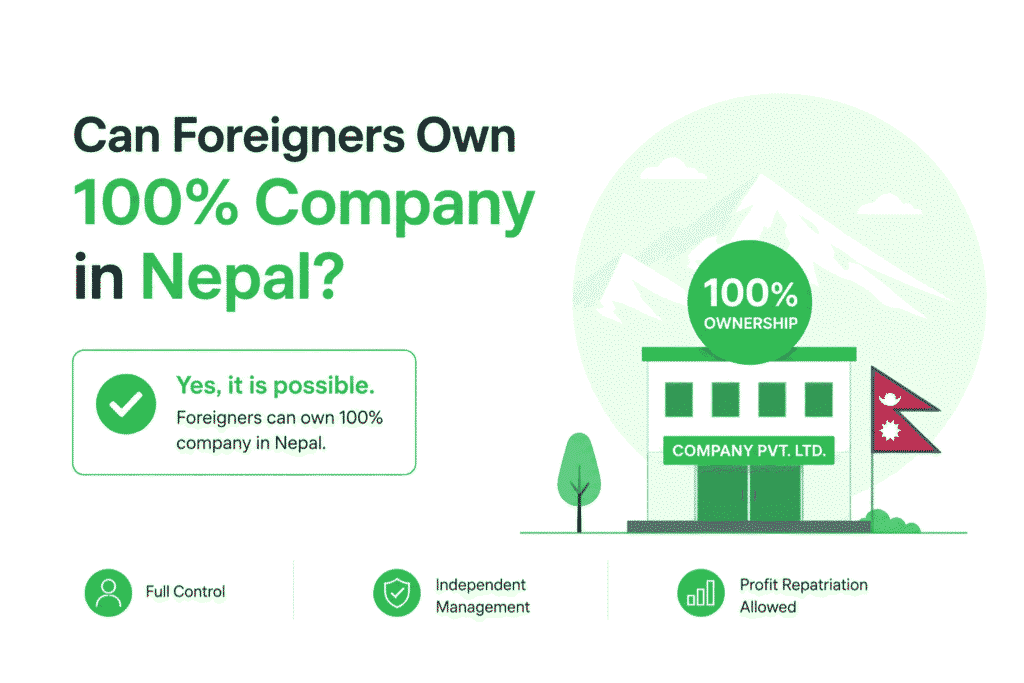
Can Foreigners Own 100% Company in Nepal? Foreign direct investment (FDI) in Nepal has gained increasing attention from international investors, entrepreneurs, and multinational corporations seeking to establish a business presence in South Asia. Nepal, positioned between two major economies India and China offers strategic geographic advantages and growing market potential. A common question among foreign nationals and international businesses is whether they can own 100% of a company in Nepal. The answer is yes, but only in specific sectors and subject to conditions laid down by Nepali law.
This article examines the legal framework governing foreign company ownership in Nepal, the sectors that allow 100% foreign ownership, the restricted and prohibited sectors, minimum investment requirements, and the process for registering a foreign-owned company in Nepal.
Legal Framework for Foreign Investment in Nepal
The primary legislation governing foreign investment in Nepal is the Foreign Investment and Technology Transfer Act, 2019 (FITTA 2019). This Act replaced the earlier Foreign Investment and Technology Transfer Act, 1992 and modernized the legal structure for attracting FDI in Nepal.
Other supporting legislation includes:
- Companies Act, 2006 — governs company incorporation and registration
- Industrial Enterprises Act, 2020 — defines industrial classifications and investment thresholds
- Special Economic Zone Act, 2016 — provides incentives for companies in SEZ areas
- Income Tax Act, 2002 — regulates tax obligations for foreign-owned entities
- Foreign Exchange Regulation Act, 1962 — controls currency repatriation
The Department of Industry (DOI) under the Ministry of Industry, Commerce and Supplies handles foreign investment approvals for standard investments. The Investment Board Nepal (IBN) manages large-scale investments above NPR 6 billion or projects of national significance.
You can access the DOI at www.doind.gov.np and Investment Board Nepal at www.ibn.gov.np.
Can a Foreigner Own 100% of a Company in Nepal?
Yes, a foreigner can own 100% equity in a company registered in Nepal, provided that the business falls within a sector that is not restricted or prohibited under the negative list of FITTA 2019. Foreign investors are not required to take a Nepali partner in most manufacturing, energy, tourism, IT, and infrastructure sectors.
However, 100% foreign ownership is not permitted in sectors listed in the negative list of FITTA 2019, which includes cottage industries, small-scale industries, retail trade, personal service businesses, and certain reserved professional services.
Sectors Where 100% Foreign Ownership Is Allowed in Nepal
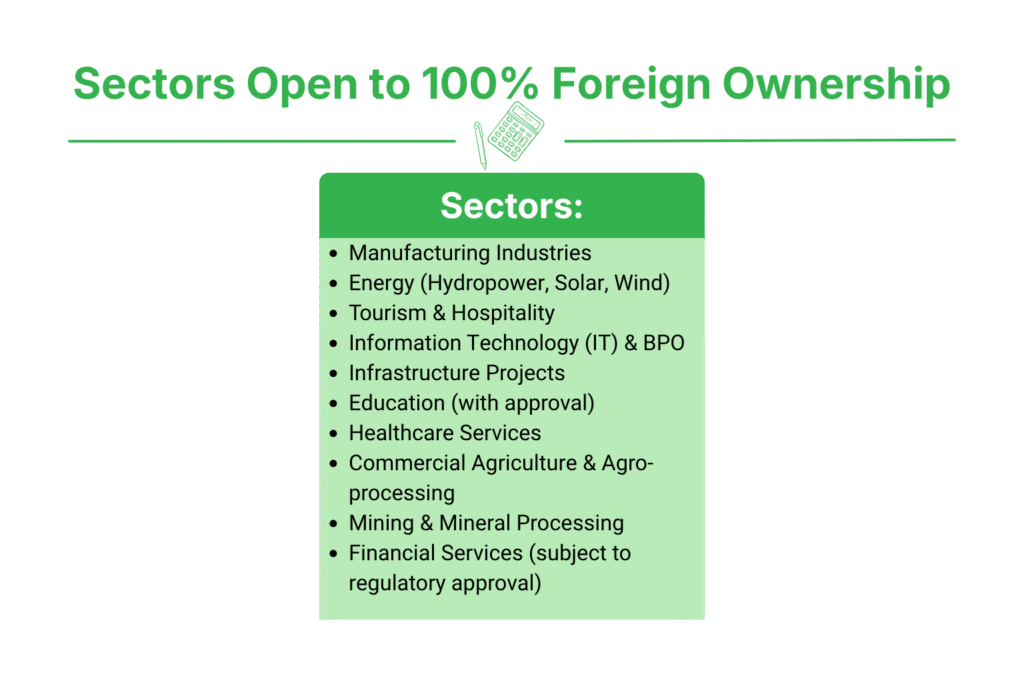
Under FITTA 2019, the following sectors are open to full foreign ownership:
- Manufacturing industries — textiles, garments, food processing, pharmaceutical, electronics
- Energy sector — hydropower, solar energy, wind energy
- Tourism and hospitality — hotels (above 3-star), resorts, adventure tourism
- Information Technology (IT) — software development, IT services, BPO
- Infrastructure — roads, bridges, airports, special infrastructure projects
- Education — private schools, colleges, and universities (subject to approval)
- Healthcare — hospitals and specialized medical centers
- Agriculture (large-scale) — commercial farming, agro-processing
- Mining and mineral processing — subject to relevant sector approvals
- Financial services — banks, insurance, with Nepal Rastra Bank approval
These sectors generally allow 100% FDI, and a foreigner or a foreign company can establish a wholly foreign-owned enterprise (WFOE) in Nepal within these categories.
Restricted and Prohibited Sectors
FITTA 2019 maintains a negative list a schedule of sectors where foreign investment is either restricted or completely prohibited. Any foreign investor must review this list before proceeding with company registration.
Sectors Prohibited for Foreign Investment:
- Industries related to arms, ammunition, and explosives manufacturing
- Industries related to atomic energy and radioactive materials
- Security printing (printing of currency, government securities)
- Any sector specifically declared off-limits by the Government of Nepal
Sectors Restricted or Reserved for Nepali Nationals:
- Cottage industries as defined under the Industrial Enterprises Act 2020
- Small-scale industries with fixed assets below NPR 150 million
- Retail trade below a specified investment threshold
- Personal service businesses beauty salons, laundry, tailoring
- Poultry farming, fishery, bee-keeping, and silkworm farming at small scale
- Mass media newspapers, FM radio, television broadcasting
- Consulting firms in engineering, law, accounting (reserved for Nepali citizens)
- Travel agencies operating below specified investment threshold
Foreign investors must verify the current negative list with the Department of Industry before making any investment decision, as the Government of Nepal can update the list through executive decisions.
Minimum Foreign Investment Requirements in Nepal
FITTA 2019 sets a minimum threshold for foreign investment in Nepal. This threshold determines whether a foreign investor can legally bring in capital and register a foreign-owned company.
| Investment Location | Minimum Foreign Investment Required |
|---|---|
| Outside Special Economic Zone (SEZ) | NPR 20,000,000 (NPR 2 Crore) |
| Inside Special Economic Zone (SEZ) | NPR 5,000,000 (NPR 50 Lakh) |
| Large-scale projects (IBN jurisdiction) | Above NPR 6,000,000,000 (NPR 6 Arba) |
The minimum investment must be brought into Nepal through banking channels and converted through a licensed commercial bank regulated by Nepal Rastra Bank.
Types of Foreign Investment Allowed Under FITTA 2019
Under Section 2 of FITTA 2019, foreign investment in Nepal can take the following forms:
- Foreign direct investment (FDI) — equity investment in shares of a Nepali company
- Foreign loan investment — loans provided by foreign investors to Nepali entities
- Technology transfer — payment for use of foreign technology, patent, or know-how
- Reinvestment of earnings — profits reinvested within Nepal from a foreign-owned entity
Process to Register a 100% Foreign-Owned Company in Nepal
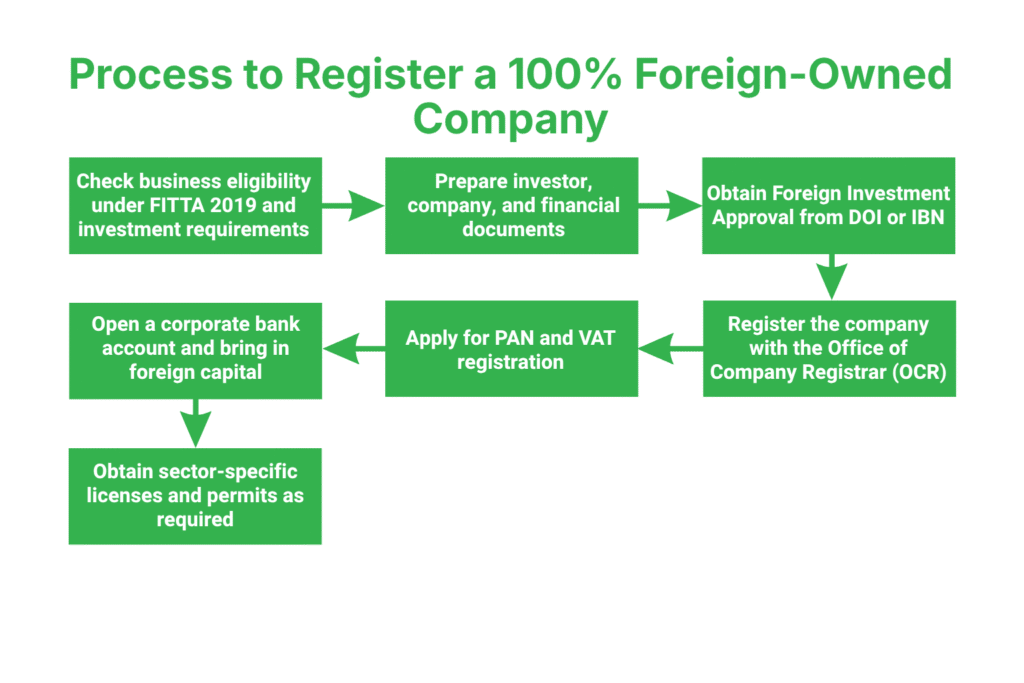
The registration of a fully foreign-owned company involves multiple government agencies and a sequential process.
Step 1: Determine Eligibility
- Confirm that the intended business activity is not in the negative list of FITTA 2019
- Verify the minimum investment requirement for the sector
Step 2: Prepare Required Documents
- Valid passport copies of all foreign investors/directors
- Board resolution (for corporate investors) authorizing the investment
- Company incorporation certificate from the country of origin (notarized and apostilled)
- Financial statements of the parent company
- Detailed project/business proposal
- Power of Attorney (if applicable)
- Bank statement showing financial capacity
- Proposed company name and articles of association
Step 3: Apply for Foreign Investment Approval
- Submit the application to the Department of Industry (DOI) or the One Window Committee
- For large investments, apply to Investment Board Nepal (IBN)
- The DOI issues a Foreign Investment Approval Certificate
Step 4: Register with Office of Company Registrar (OCR)
- Submit the OCR registration form along with DOI approval
- Provide Memorandum of Association (MoA) and Articles of Association (AoA)
- Pay the registration fee based on authorized capital
- The OCR at www.ocr.gov.np issues the Certificate of Incorporation
Step 5: Register for PAN and VAT
- Apply for Permanent Account Number (PAN) at the Inland Revenue Department
- Apply for VAT registration if annual turnover exceeds the threshold
Step 6: Open a Corporate Bank Account
- Open a bank account in a Nepal Rastra Bank-licensed commercial bank
- Transfer the foreign capital through proper banking channels
Step 7: Obtain Sector-Specific Licenses
- Apply for relevant operational licenses depending on sector (tourism license, food license, etc.)
Key Comparison: Foreign Ownership in Different Business Types
| Company Type | 100% Foreign Ownership Allowed? | Minimum Investment | Applicable Law |
|---|---|---|---|
| Private Limited Company (Pvt. Ltd.) | Yes (in eligible sectors) | NPR 20 Million | Foreign Investment and Technology Transfer Act, 2075 + Companies Act, 2063 |
| Public Limited Company | Yes (in eligible sectors) | NPR 20 Million | Foreign Investment and Technology Transfer Act, 2075 + Companies Act, 2063 |
| Branch Office of Foreign Company | Yes (in eligible sectors) | NPR 20 Million | Companies Act, 2063 |
| SEZ Company | Yes (in SEZ-eligible sectors) | NPR 5 Million | Special Economic Zone Act, 2073 + Foreign Investment and Technology Transfer Act, 2075 |
| Cottage or Small Industry | No | N/A | Industrial Enterprises Act, 2076 |
| Retail Trade (small scale) | No | N/A | Foreign Investment and Technology Transfer Act, 2075 (Negative List) |
Tax Incentives for Fully Foreign-Owned Companies in Nepal
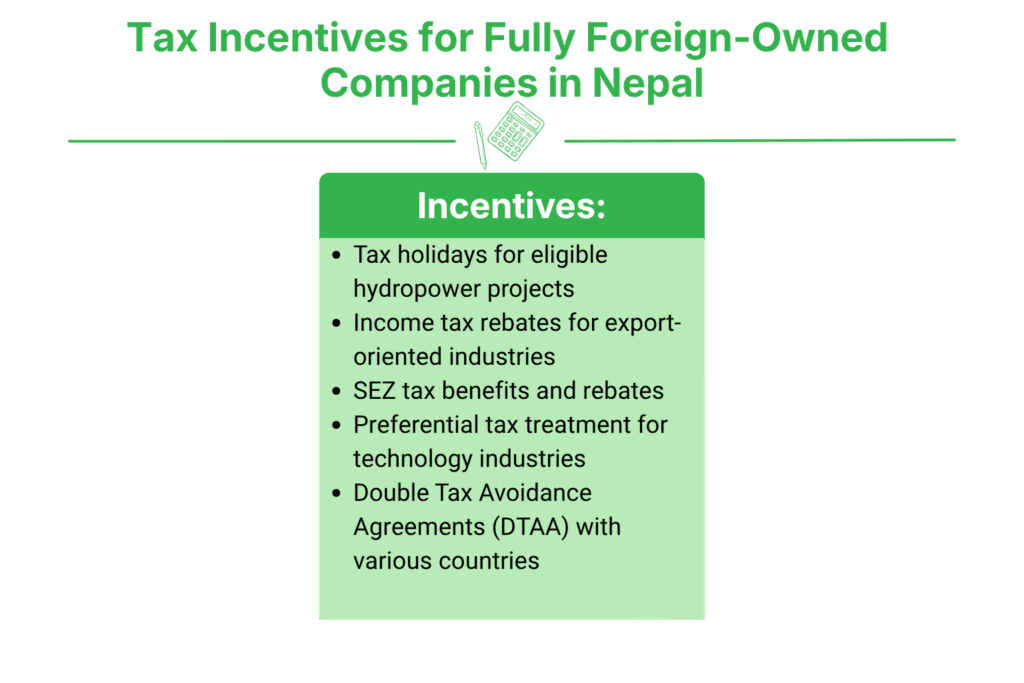
Nepal offers several tax benefits to attract foreign investors:
- Hydropower projects: Tax holiday for up to 10 years from operation start
- Export-oriented industries: Income tax rebates on export earnings
- SEZ companies: Tax holiday for the first 5 years, 50% rebate for next 3 years
- Technology-based industries: Preferential tax treatment
- No double taxation: Nepal has Double Tax Avoidance Agreements (DTAA) with several countries
Foreign investors can also repatriate profits, dividends, and principal capital after paying applicable taxes, as guaranteed under Section 10 of FITTA 2019.
FAQs
1. Can a single foreigner own 100% of a company in Nepal?
Yes. A single foreign national can own 100% equity in a company in Nepal if the business is in an eligible sector under FITTA 2019, and the minimum investment requirement of NPR 20 million is met outside SEZ areas.
2. Is a Nepali partner mandatory for foreign-owned companies?
No. A Nepali co-founder or partner is not legally required in sectors open to 100% FDI. However, a Nepali partner is required in sectors partially restricted under the negative list of FITTA 2019.
3. What is the minimum investment for a foreign company in Nepal?
The minimum foreign investment is NPR 20 million (NPR 2 Crore) for businesses outside SEZ. Inside SEZ areas, the minimum is NPR 5 million (NPR 50 Lakh) as per FITTA 2019.
4. Can a foreigner own land in Nepal for business purposes?
No. Foreign nationals and foreign-owned companies cannot own land in Nepal under the Land (Measurement and Survey) Act and related laws. However, they can lease land for business operations for extended periods.
5. How long does company registration take for a foreign investor in Nepal?
The full process, including DOI approval and OCR registration, typically takes 30 to 60 working days, depending on document completeness and sector-specific approvals required.
6. Can a foreign company repatriate profits from Nepal?
Yes. Section 10 of FITTA 2019 guarantees the right of foreign investors to repatriate profits, dividends, and capital after paying applicable taxes, through banking channels approved by Nepal Rastra Bank.
Conclusion
Foreign nationals can own 100% of a company in Nepal in sectors that fall outside the negative list of FITTA 2019. The legal framework under FITTA 2019, the Companies Act 2006, and the Industrial Enterprises Act 2020 collectively govern foreign company ownership in Nepal. Full foreign ownership is permitted in manufacturing, energy, IT, tourism, and infrastructure sectors, while cottage industries, small-scale industries, retail trade, and certain professional services remain restricted. Foreign investors must meet the minimum investment threshold of NPR 20 million outside SEZ areas and follow the prescribed registration process through the Department of Industry and Office of Company Registrar. Understanding the negative list and sector-specific rules is the first and most essential step before registering a foreign-owned company in Nepal.