

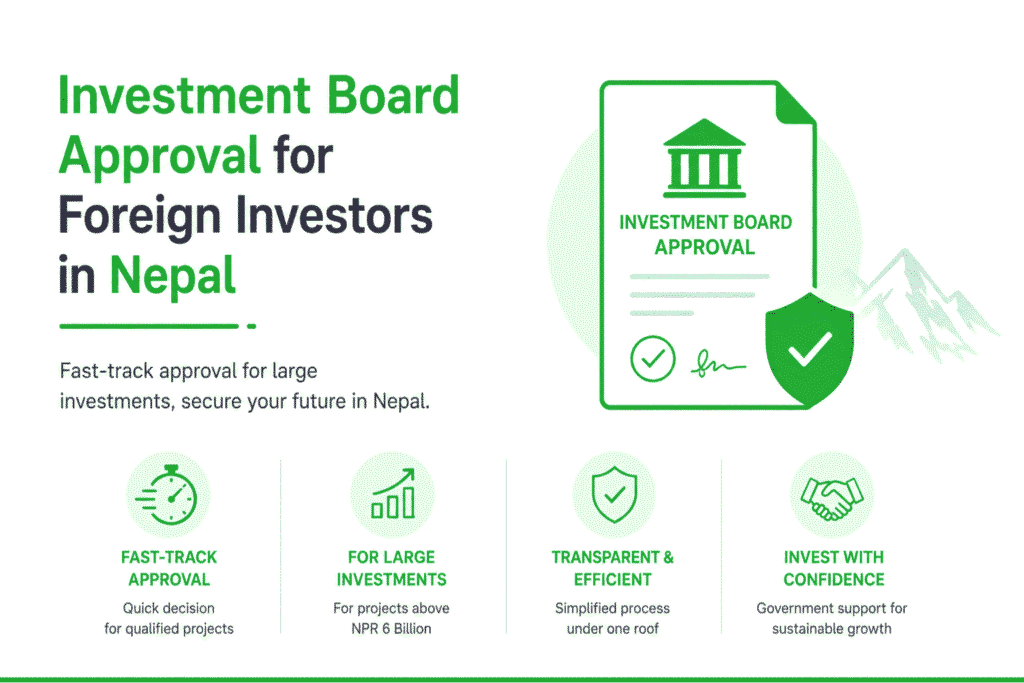
Foreign direct investment (FDI) in Nepal follows a structured legal framework that requires foreign investors to obtain proper approvals before committing capital. The Investment Board Nepal (IBN) serves as the primary government body responsible for facilitating, approving, and monitoring large-scale foreign investments in Nepal. Understanding the Investment Board approval for foreign investors in Nepal planning to enter the Nepali market.
What is the Investment Board Nepal (IBN)?
The Investment Board Nepal (IBN) is a high-level government institution established under the Investment Board Act, 2011 (2068 B.S.). It operates under the chairmanship of the Prime Minister of Nepal, which reflects its strategic importance in the national economy.
IBN serves as a one-stop service center for investors seeking approvals for large-scale projects. The board facilitates foreign direct investment by reducing bureaucratic delays, coordinating with relevant government agencies, and providing investment-related services under one roof.
The Investment Board Act was later supplemented by the Foreign Investment and Technology Transfer Act (FITTA), 2019 (2076 B.S.), which governs the entry, operation, and exit of foreign investment in Nepal more broadly.
Official Website: Investment Board Nepal
What Laws Govern Foreign Investment Approval in Nepal?
Foreign investment approvals in Nepal are governed by several key laws:
| Law | Year | Purpose |
|---|---|---|
| Investment Board Act, 2068 | 2011 | Establishes Investment Board Nepal and governs large-scale project approvals |
| Foreign Investment and Technology Transfer Act, 2075 | 2019 | Governs FDI entry, repatriation, and technology transfer |
| Industrial Enterprises Act, 2076 | 2020 | Regulates industrial enterprises including foreign-invested ones |
| Special Economic Zone Act, 2073 | 2016 | Governs investments within SEZs |
| Companies Act, 2063 | 2006 | Governs company registration procedures |
Under Section 3 of the Investment Board Act, 2011, the board holds authority to approve, monitor, and facilitate investments in projects of national significance. Under Section 5 of FITTA, 2019, foreign investors may invest in Nepal through equity, loan, or technology transfer, subject to approval from the relevant authority.
Which Investments Require Investment Board Nepal Approval?
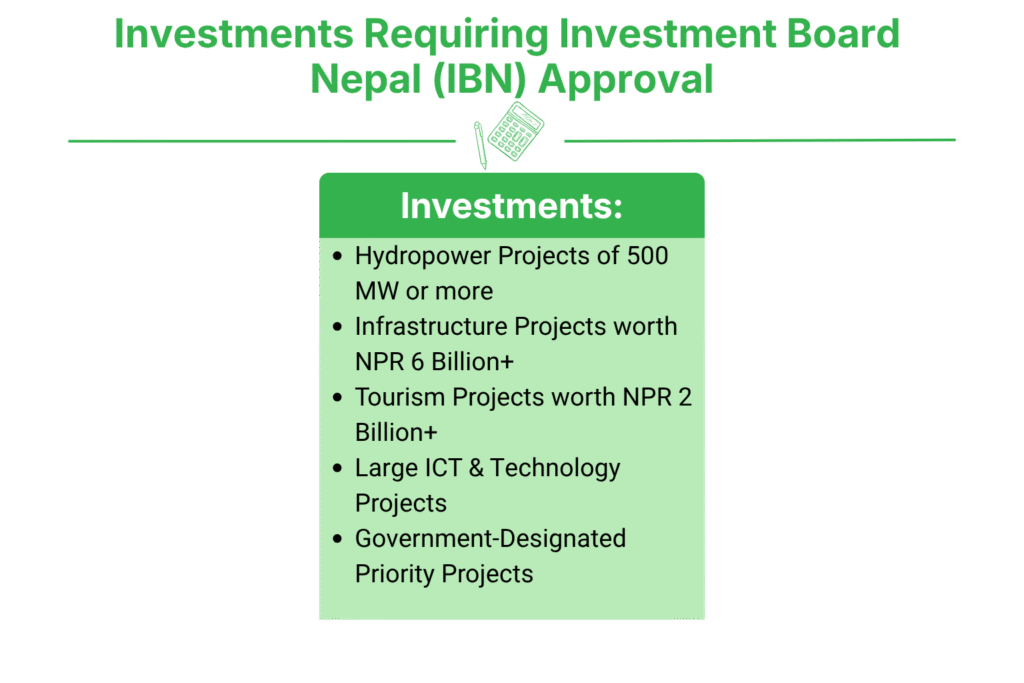
Not all foreign investments go through the Investment Board Nepal. IBN specifically handles large-scale and strategic investments that cross a defined financial threshold.
According to the Investment Board Act and its subsequent amendments, the following categories of investment require IBN approval:
- Hydropower projects with a capacity of 500 MW or more
- Infrastructure projects with a total investment of NPR 6 billion (approximately USD 45 million) or more
- Tourism projects with an investment of NPR 2 billion or more
- ICT and technology projects above a prescribed threshold
- Any special priority project designated by the Government of Nepal
Projects below these thresholds may seek approval from the Department of Industry (DoI) under the Ministry of Industry, Commerce and Supplies, or from sectoral authorities, rather than IBN directly.
Official Reference: Department of Industry Nepal
What is the Role of the One-Stop Service Center at IBN?
The One-Stop Service Center (OSSC) at IBN is one of its most significant functional units. It was established to reduce the time and effort foreign investors spend dealing with multiple government agencies.
Under the OSSC, the following services are available at a single location:
- Company registration coordination with the Office of Company Registrar
- Industry registration through the Department of Industry
- Tax registration (PAN/VAT) through the Inland Revenue Department
- Land acquisition facilitation
- Environmental Impact Assessment (EIA) clearance coordination
- Visa and work permit facilitation for foreign personnel
- Approval for repatriation of profits and dividends
This integrated system aligns with the Government of Nepal’s policy to improve the Ease of Doing Business ranking and attract more foreign direct investment into priority sectors.
What Are the Eligible Sectors for Foreign Direct Investment in Nepal?
FITTA, 2019 allows foreign investment in most sectors, but the Government of Nepal has reserved certain sectors exclusively for Nepali nationals or restricted FDI based on national interest.
Sectors Open to Foreign Investment:
- Hydropower and energy
- Tourism, hotels, and resorts
- Manufacturing and industrial production
- Information and communication technology
- Education and healthcare (with conditions)
- Infrastructure including roads, bridges, and airports
- Mining and minerals
- Financial services (banking, insurance with sectoral limits)
Restricted or Closed Sectors (as per Negative List under FITTA, 2019 and related directives):
- Cottage and small industries
- Personal service businesses (beauty parlors, tailoring below threshold)
- Retail trade (with specific exceptions)
- Mass media and publishing (with restrictions)
- Arms and ammunition
- Real estate business (purchase and sale of land)
- Poultry farming, fisheries, and agriculture below certain scales
Foreign investors must verify the current Negative List published by the Department of Industry before applying to IBN or DoI for approval.
What is the Step-by-Step Process for Obtaining Investment Board Approval?
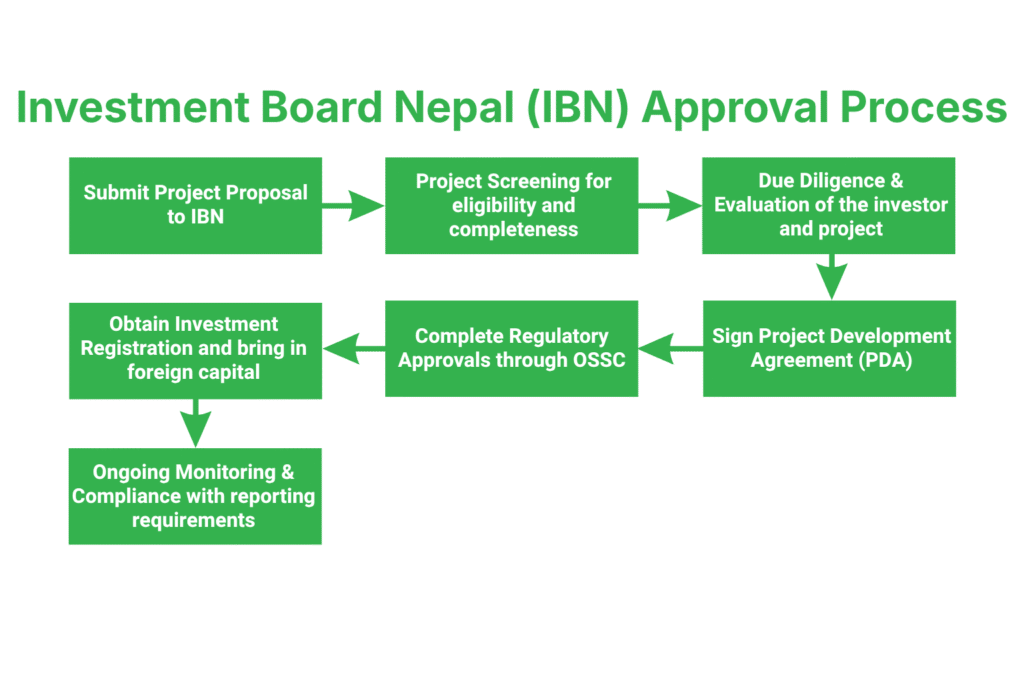
The investment approval process through IBN follows a structured procedure. The steps below reflect the process as defined under the Investment Board Act, 2011 and IBN’s operational guidelines:
Step 1: Project Proposal Submission
The foreign investor submits a formal project proposal to IBN. The proposal must include a detailed project report, financial projections, technical feasibility study, and ownership structure details.
Step 2: Project Screening
IBN’s secretariat reviews the proposal for completeness and eligibility. The project is evaluated based on sector, investment size, and alignment with national development priorities.
Step 3: Due Diligence and Evaluation
IBN conducts due diligence on the investor’s financial capacity, technical expertise, and track record. Relevant line ministries and departments are consulted during this phase.
Step 4: Project Development Agreement (PDA)
For approved projects, IBN signs a Project Development Agreement (PDA) with the investor. This agreement defines the rights, obligations, timeline, and conditions for the project.
Step 5: One-Stop Service Facilitation
After PDA signing, the investor accesses the OSSC for company registration, PAN/VAT registration, land-related approvals, environmental clearances, and other regulatory formalities.
Step 6: Investment Approval and Registration
The investment is formally registered. The foreign investor can then bring capital into Nepal through approved banking channels as per Nepal Rastra Bank (NRB) directives.
Step 7: Monitoring and Compliance
IBN monitors the project’s implementation progress. The investor must submit periodic progress reports as required under the PDA and applicable law.
What Documents Does a Foreign Investor Need to Submit to IBN?
Foreign investors must submit the following documents when applying for Investment Board approval:
- Company profile of the investing entity with audited financial statements
- Board resolution authorizing investment in Nepal
- Certificate of incorporation from the home country (notarized and apostilled)
- Detailed Project Report (DPR) including technical and financial feasibility
- Environmental and social impact assessment (preliminary or full, depending on project)
- Power of Attorney if applying through a representative
- Proof of financial capacity (bank statements, credit ratings)
- Technology transfer agreement (if applicable)
- Project site details and land-use plan
- Passports of key directors and shareholders of the investing entity
All foreign-language documents must be translated into Nepali or English and certified accordingly.
What Are the Key Benefits for Foreign Investors Under Nepal’s Investment Laws?
Nepal’s legal framework provides several guarantees and incentives to foreign investors under FITTA, 2019 and the Investment Board Act, 2011.
| Benefit | Legal Provision |
|---|---|
| Repatriation of profits and dividends | Foreign Investment and Technology Transfer Act, 2075 Section 10 |
| Protection against nationalization | Foreign Investment and Technology Transfer Act, 2075 Section 9 |
| Visa facilitation for investor and technical personnel | IBN OSSC Services (Investment Board Nepal facilitation services) |
| Tax holidays for priority sectors | Industrial Enterprises Act, 2076 |
| Access to foreign currency for repayment | Nepal Rastra Bank Foreign Exchange Guidelines |
| Dispute resolution through arbitration | Foreign Investment and Technology Transfer Act, 2075 Section 17 |
Under Section 17 of FITTA, 2019, foreign investors have the right to resolve disputes through international arbitration if domestic resolution fails, which provides a significant legal assurance to foreign capital.
How Does IBN Coordinate with Other Government Agencies?
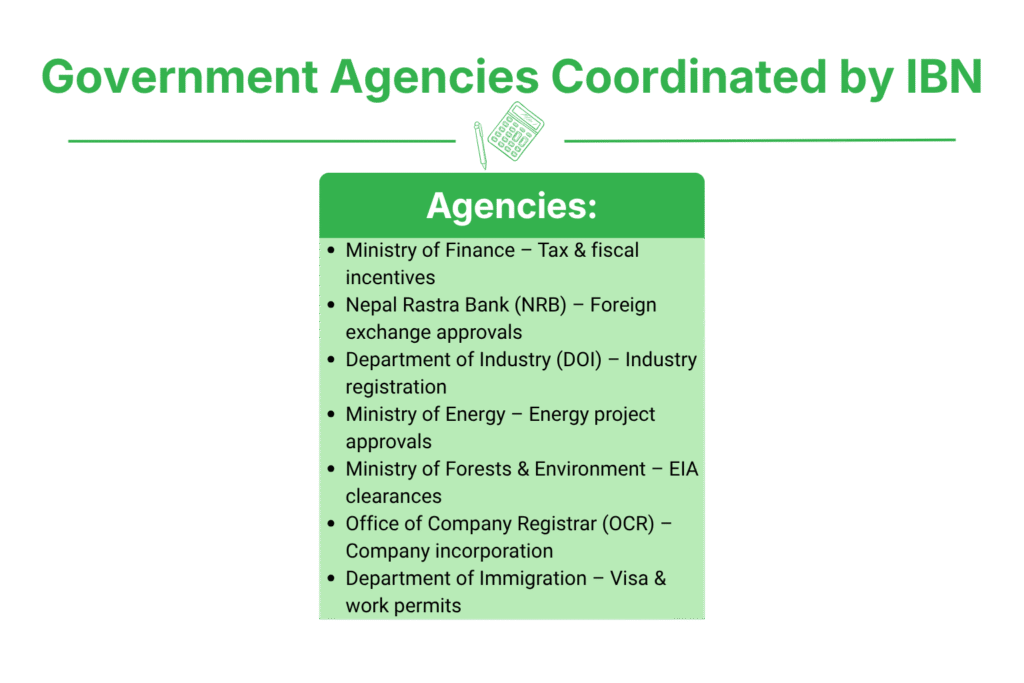
IBN does not operate in isolation. It coordinates with multiple government bodies to deliver integrated services to foreign investors:
- Ministry of Finance — for tax and fiscal incentives
- Nepal Rastra Bank (NRB) — for foreign exchange approvals and capital transfer
- Department of Industry — for industry registration below IBN threshold
- Ministry of Energy — for hydropower and energy project clearances
- Ministry of Forests and Environment — for EIA approvals
- Office of Company Registrar — for company incorporation
- Department of Immigration — for visa and work permits
This multi-agency coordination through the OSSC significantly reduces the time investors need to secure all regulatory clearances.
What is the Minimum Foreign Investment Threshold in Nepal?
Under FITTA, 2019, the minimum foreign investment threshold for projects outside IBN’s jurisdiction is NPR 50 million (approximately USD 375,000). Investments below this threshold do not qualify as foreign direct investment under FITTA and cannot receive FDI-related protections and benefits.
For projects under IBN’s jurisdiction, the threshold is significantly higher as described earlier, ranging from NPR 2 billion for tourism projects to NPR 6 billion for general infrastructure projects.
FAQs
1. What is the Investment Board Nepal (IBN)?
IBN is a government institution established under the Investment Board Act, 2011. It approves, facilitates, and monitors large-scale foreign and domestic investments in Nepal, chaired by the Prime Minister.
2. Is IBN required for all foreign investments in Nepal?
No. IBN approval is required only for large-scale projects above defined financial thresholds. Smaller foreign investments are approved by the Department of Industry under FITTA, 2019.
3. What is the minimum investment to qualify for IBN approval?
For infrastructure projects, the minimum is NPR 6 billion. For tourism, it is NPR 2 billion. For hydropower projects, it is 500 MW capacity or above, as per the Investment Board Act, 2011.
4. Can foreign investors repatriate profits from Nepal?
Yes. Under Section 10 of FITTA, 2019, foreign investors can repatriate profits, dividends, and proceeds from the sale of shares after paying applicable taxes, subject to Nepal Rastra Bank regulations.
5. What is a Project Development Agreement (PDA) in IBN?
A PDA is a legal agreement between IBN and the investor that defines project scope, timelines, rights, obligations, and conditions for implementation. It is signed after project approval by IBN.
6. Where can foreign investors get more information about IBN approval?
Foreign investors can visit the official IBN website at ibn.gov.np or contact IBN’s One-Stop Service Center directly for guidance on project proposals, approvals, and facilitation services.
Conclusion
The Investment Board Nepal serves as the central gateway for large-scale foreign direct investment in Nepal. The approval process involves detailed project evaluation, legal agreements, and multi-agency coordination. Foreign investors must align their projects with Nepal’s legal framework under the Investment Board Act, 2011, FITTA, 2019, and the Industrial Enterprises Act, 2020 to secure valid investment approval and access the full range of legal protections and incentives available in Nepal.