


Nepal has emerged as a promising destination for foreign investors seeking business opportunities in South Asia. The country’s strategic location between India and China, combined with a young workforce and growing economy, makes it an attractive market. Premium business setup services in Nepal for foreigners provide end-to-end assistance in company registration, legal compliance, foreign investment approval, and operational setup. Understanding the legal framework, required documents, and registration processes is essential for any foreign national or entity planning to establish Premium Business Setup Services in Nepal for Foreigners.
What is the Legal Framework for Foreign Business Setup in Nepal?
The primary legislation governing foreign investment and business setup in Nepal is the Foreign Investment and Technology Transfer Act, 2019 (FITTA 2019). This Act replaced the earlier FITTA 1992 and brought significant reforms to attract foreign direct investment (FDI) in Nepal.
Other key laws include:
- Companies Act, 2006 (2063 B.S.) – Governs the incorporation and operation of companies in Nepal
- Industrial Enterprises Act, 2020 (2076 B.S.) – Regulates industrial enterprises and provides incentives
- One Stop Service Act, 2074 B.S. – Facilitates a unified registration process for foreign investors
- Income Tax Act, 2058 B.S. – Defines tax obligations for businesses in Nepal
- Nepal Rastra Bank Act, 2058 B.S. – Governs foreign currency transactions and repatriation of profits
- Special Economic Zone Act, 2073 B.S. – Provides benefits for businesses operating in SEZs
The Department of Industry (DOI) under the Ministry of Industry, Commerce and Supplies is the primary regulatory body for foreign investment approval in Nepal. For large-scale investments exceeding NPR 6 billion, the Investment Board Nepal (IBN) handles the approval process.
What Types of Business Entities Can Foreigners Register in Nepal?
Foreign nationals and foreign companies can establish different types of business entities in Nepal depending on their investment goals and ownership preferences.
| Business Entity Type | Foreign Ownership Allowed | Minimum Investment (FDI) | Governing Authority |
|---|---|---|---|
| Private Limited Company (Pvt. Ltd.) | Up to 100% | NPR 20 million (approx. USD 150,000) | Office of Company Registrar + Department of Industry |
| Public Limited Company | Up to 100% | NPR 20 million | Office of Company Registrar + Department of Industry |
| Joint Venture Company | Partial foreign ownership | NPR 20 million | Office of Company Registrar + Department of Industry |
| Branch Office | Foreign company extension | As per parent company | Department of Industry |
| Liaison / Representative Office | Non-commercial activities | Not applicable | Department of Industry |
| Partnership Firm | Limited foreign participation | Subject to FITTA 2019 | Department of Industry |
A Private Limited Company is the most commonly chosen structure by foreign investors in Nepal due to its flexibility and limited liability protection. A Joint Venture with a Nepali partner is another preferred option for accessing local market knowledge and networks.
What Are the Minimum Investment Requirements for Foreign Investors?
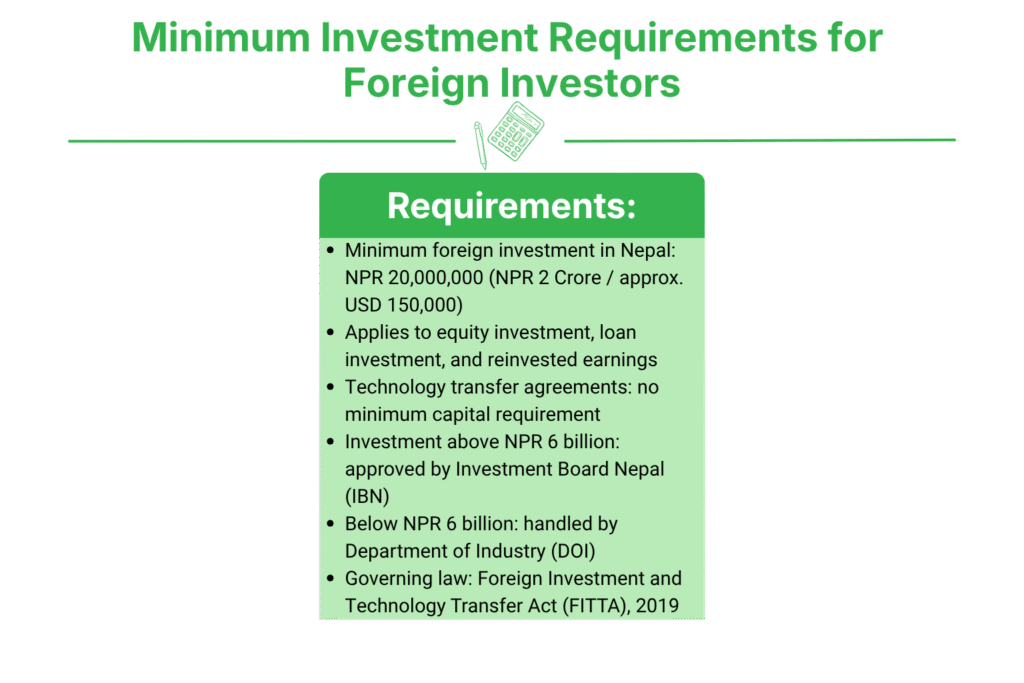
Under FITTA 2019, Section 3, foreign investors must meet the following minimum investment thresholds to establish a business in Nepal:
- Minimum foreign investment: NPR 20,000,000 (NPR 2 Crore or approximately USD 150,000)
- This threshold applies to equity investment, loan investment, or reinvestment of earnings
- Technology transfer agreements do not require a minimum capital threshold
- For investments exceeding NPR 6 billion, the Investment Board Nepal (IBN) is the approving authority
The Nepal Rastra Bank (NRB) regulates foreign currency transactions. Foreign investors must bring investment funds through banking channels and obtain approval from NRB for remittances and profit repatriation.
Which Sectors Are Open and Restricted for Foreign Investment in Nepal?
Not all business sectors in Nepal are open for foreign investment. The Government of Nepal has classified sectors into permitted, restricted, and prohibited categories.
Sectors Open for Foreign Investment:
- Manufacturing and production industries
- Tourism, hospitality, and trekking agencies
- Information technology and software development
- Hydropower and energy production
- Agro-processing and food industries
- Education and healthcare institutions
- Construction and infrastructure
- Financial services (with NRB approval)
- Export-oriented industries
Sectors Restricted or Prohibited for Foreign Investment (Schedule 1 of FITTA 2019):
- Cottage and small industries traditionally run by Nepali citizens
- Personal service businesses (e.g., hair salons, tailoring shops)
- Poultry farming, fisheries below a certain scale
- Travel agencies below a defined capital threshold
- Arms and ammunition manufacturing
- Currency printing and security printing
- Real estate business (direct land purchase)
- Mass communication and media (newspapers, FM radio, television)
- Retail trade below specified investment limits
Foreign investors must verify the Negative List published under FITTA 2019 before proceeding with their business plan. The DOI website (www.doind.gov.np) publishes updated lists of restricted and permitted sectors.
What is the Step-by-Step Process for Business Registration in Nepal for Foreigners?
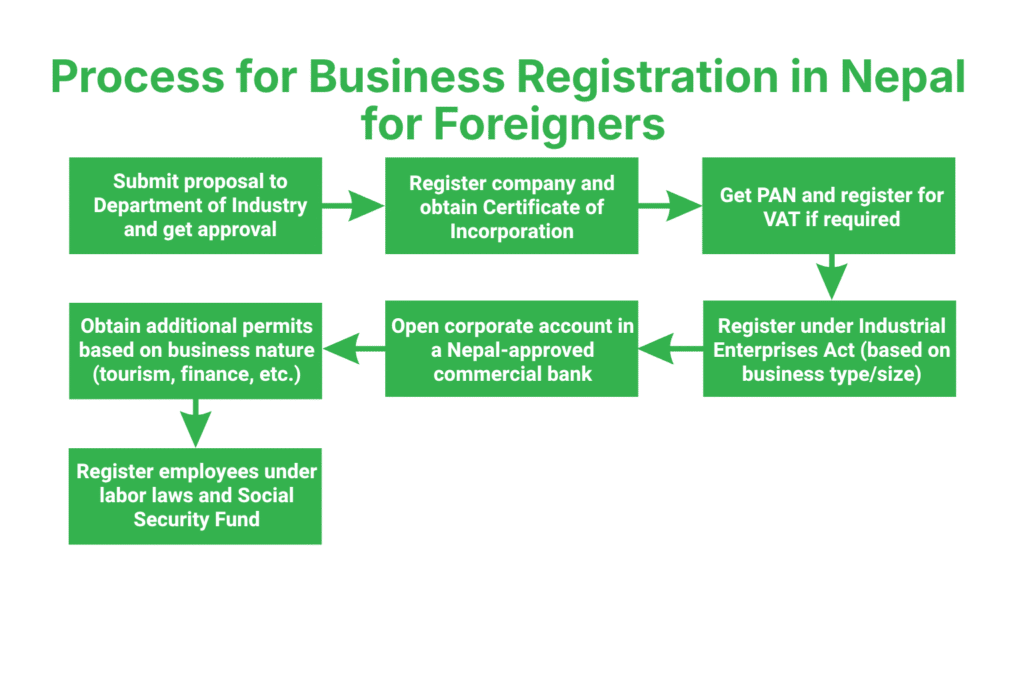
The business registration process for foreign investors in Nepal involves multiple government agencies. Premium business setup services in Nepal streamline this process by handling all documentation and approvals on behalf of the client.
Step 1: Obtain Foreign Investment Approval from DOI
- Submit an application to the Department of Industry (DOI) (www.doind.gov.np)
- DOI reviews the proposed business activity, investment amount, and sector eligibility
- Approval is typically granted within 7 working days under the One Stop Service system
Step 2: Company Registration at Office of Company Registrar (OCR)
- Submit the Memorandum of Association (MOA) and Articles of Association (AOA)
- Pay registration fees as per the Companies Act, 2006
- Obtain the Certificate of Incorporation from OCR (www.ocr.gov.np)
Step 3: Register at Inland Revenue Department (IRD)
- Obtain a Permanent Account Number (PAN) from the IRD
- Register for Value Added Tax (VAT) if annual turnover exceeds NPR 5 million
- Register for excise duty if applicable to the business
Step 4: Obtain Industry Registration Certificate
- Register the business as an industrial enterprise under the Industrial Enterprises Act, 2020
- Classification: Micro, Cottage, Small, Medium, or Large Industry
Step 5: Open a Corporate Bank Account
- Open a corporate bank account in a commercial bank approved by NRB
- Foreign investment funds must be remitted through this account
- Submit Foreign Investment Approval Letter to the bank
Step 6: Obtain Sector-Specific Licenses
- Depending on the business type, additional licenses may be required from respective ministries
- Tourism businesses require a license from the Department of Tourism
- Financial businesses require approval from Nepal Rastra Bank
Step 7: Register with Social Security Fund and Labor Department
- Register employees under the Social Security Act, 2074 B.S.
- Comply with Labor Act, 2074 B.S. for employment contracts
What Documents Are Required for Foreign Business Registration in Nepal?
The documentation requirements differ slightly based on whether the applicant is an individual foreign investor or a foreign company.
For Individual Foreign Investors:
- Valid passport copy (notarized)
- Recent passport-size photographs
- Proof of investment funds (bank statement)
- Business plan or project proposal
- Draft MOA and AOA
- Power of Attorney (if applying through an agent)
- Criminal background clearance certificate
For Foreign Companies Investing in Nepal:
- Certificate of Incorporation of the parent company (notarized and apostilled)
- Board resolution authorizing investment in Nepal
- Audited financial statements of the parent company (last 3 years)
- MOA and AOA of the parent company
- Company profile and business plan for Nepal operations
- Power of Attorney in favor of the Nepal representative
- Tax clearance certificate from the home country
All foreign documents must be notarized and apostilled (or attested by the Nepali Embassy in the respective country) before submission.
What Are the Tax Obligations for Foreign-Owned Businesses in Nepal?
Foreign-owned businesses in Nepal are subject to the same tax regime as domestic companies under the Income Tax Act, 2058 B.S.
| Tax Type | Rate | Applicable To |
|---|---|---|
| Corporate Income Tax | 25% (standard rate) | All companies |
| Corporate Income Tax (Manufacturing) | 20% | Manufacturing industries |
| Special Industry Tax Rate | 20% | Export-oriented industries |
| Dividend Withholding Tax | 5% | Dividend distribution to shareholders |
| Value Added Tax (VAT) | 13% | Goods and services above NPR 5 million annual turnover |
| Customs Duty | Varies | Import of goods and machinery |
| Social Security Contribution (Employer) | 20% of basic salary | All employers |
Foreign investors can repatriate profits, dividends, and capital after paying applicable taxes and obtaining NRB approval. Under FITTA 2019, Section 10, foreign investors have the legal right to repatriate:
- Profits and dividends after tax
- Principal amount of investment
- Proceeds from the sale of shares
- Payments received for technology transfer
What are Premium Business Setup Services in Nepal for Foreigners?
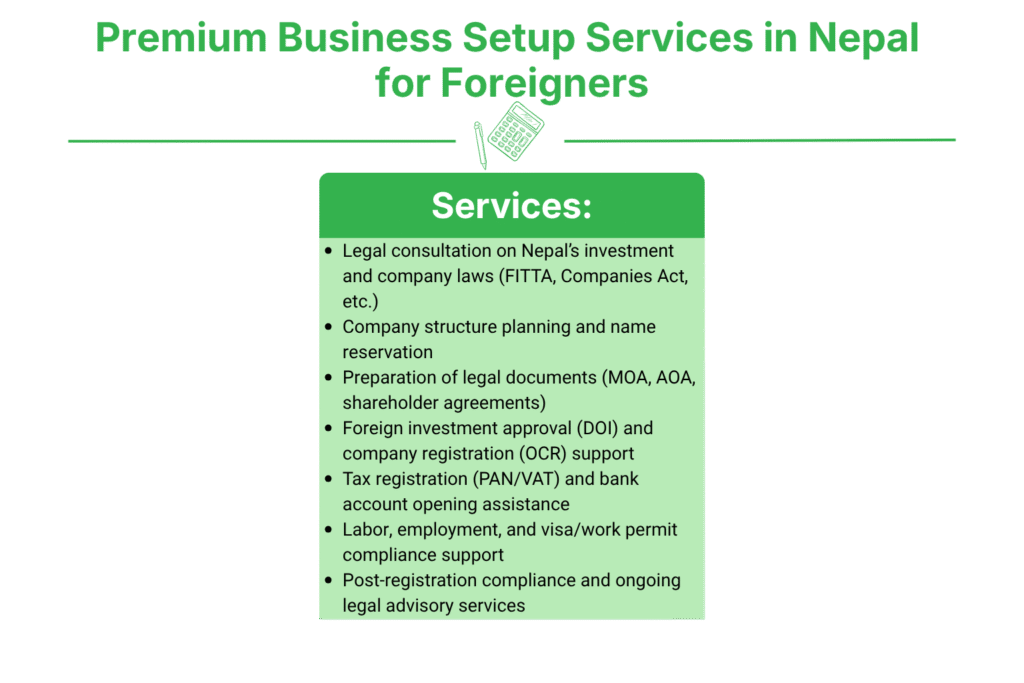
Premium business setup services in Nepal for foreigners are professional consultancy services offered by law firms, accounting firms, and business consultants. These services cover the entire lifecycle of establishing a foreign-owned business in Nepal.
Services Included in Premium Business Setup Packages:
- Legal consultation on applicable laws (FITTA 2019, Companies Act, Industrial Enterprises Act)
- Name reservation and company structure planning
- Document preparation – MOA, AOA, shareholder agreements
- DOI approval processing and follow-up
- OCR registration and incorporation
- PAN and VAT registration at IRD
- Bank account opening assistance
- Labor and employment compliance setup
- Visa and work permit support for foreign directors and employees
- Post-registration compliance management
- Ongoing legal retainer services
Premium service providers also assist with business visa applications, Non-Tourist Visa (NTV) for business purposes, and work permit applications for foreign employees under the Department of Labor and Occupational Safety.
FAQs
1. Can a foreigner own 100% of a company in Nepal?
Yes. Under FITTA 2019, a foreign investor can own up to 100% equity in a Nepali company in permitted sectors. However, certain sectors require joint venture partnerships with Nepali citizens or have restrictions on full foreign ownership.
2. What is the minimum investment required for foreign business setup in Nepal?
The minimum foreign direct investment (FDI) threshold in Nepal is NPR 20 million (approximately USD 150,000) as mandated under FITTA 2019. This applies to equity, loan, or reinvested earnings.
3. How long does company registration take for foreigners in Nepal?
The registration process typically takes 15 to 30 working days depending on the sector, document completeness, and DOI processing time. The One Stop Service Center expedites certain approvals within 7 working days.
4. Can a foreign company open a branch office in Nepal?
Yes. A foreign company can establish a branch office or liaison office in Nepal by obtaining approval from the DOI. A branch office can conduct commercial activities, while a liaison office is limited to non-revenue activities.
5. Are there any tax incentives for foreign investors in Nepal?
Yes. Under the Industrial Enterprises Act, 2020, foreign investors in priority sectors such as hydropower, manufacturing, and export industries receive tax holidays ranging from 5 to 10 years and reduced income tax rates.
6. Do foreign business owners need a visa or work permit in Nepal?
Yes. Foreign nationals working in their Nepal-registered company require a Business Visa and a Work Permit issued by the Department of Labor and Occupational Safety. Business visas are issued by the Department of Immigration (www.immigration.gov.np).
Conclusion
Setting up a business in Nepal as a foreign investor requires thorough understanding of laws such as FITTA 2019, the Companies Act 2006, and the Industrial Enterprises Act 2020. The process involves multiple government agencies including DOI, OCR, IRD, and NRB. Premium business setup services in Nepal for foreigners simplify this complex process by managing documentation, approvals, and compliance requirements. Foreign investors should engage qualified legal and financial professionals to ensure full compliance with Nepali law and to protect their investment interests from the outset.