
Best Debt Recovery Service in Nepal is a subject that affects thousands of businesses, financial institutions, and individual creditors every year. Whether you are a bank trying to recover a non-performing loan, a business dealing with unpaid invoices, or an individual owed money by a borrower, understanding how debt recovery works in Nepal is essential. Nepal has a structured legal framework governing debt recovery, and knowing the right service, the right process, and the right legal provisions can make a significant difference in how quickly and effectively you recover your money.
What Is Debt Recovery in Nepal?
Debt recovery in Nepal refers to the legal and procedural process through which a creditor whether a bank, financial institution, business entity, or individual reclaims money owed by a debtor who has defaulted on payment obligations.
Debt recovery in Nepal is governed primarily by the following laws:
- The Bank and Financial Institution Act, 2073 (2017)
- The Debt Recovery Tribunal Act, 2058 (2002)
- The Civil Code of Nepal, 2074 (2017)
- The Insolvency Act, 2063 (2007)
- The Contract Act, 2056 (2000)
The Debt Recovery Tribunal Act, 2058 is the most specific legislation dealing with recovery of loans and advances made by banks and financial institutions. It established specialized tribunals to handle such cases more efficiently than ordinary civil courts.
Why Is Debt Recovery Service Needed in Nepal?
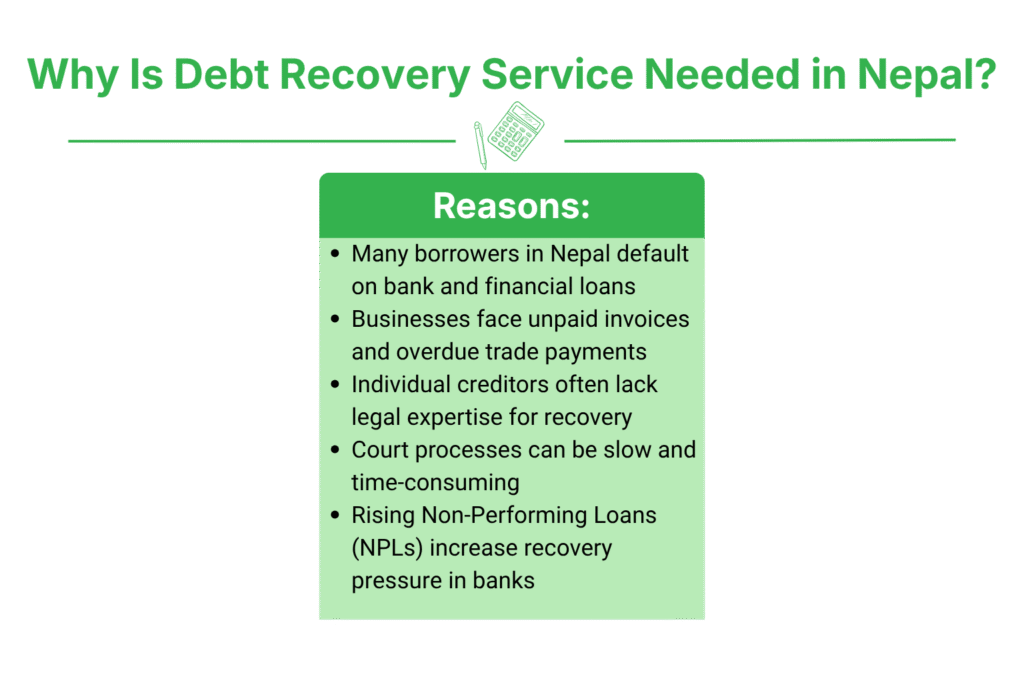
Debt recovery services in Nepal are needed because:
- Many borrowers default on loans from banks and financial institutions.
- Businesses frequently deal with unpaid trade credit and overdue invoices.
- Individual creditors often lack the legal knowledge to pursue recovery independently.
- The general court system in Nepal can be slow, making specialized services and tribunals necessary.
- Non-Performing Loans (NPLs) in Nepalese banks have consistently remained a concern for the financial sector.
According to the Nepal Rastra Bank (NRB), Non-Performing Loans of commercial banks have periodically exceeded 3–4% of total loans, indicating a substantial volume of debt recovery cases annually.
Legal Framework for Debt Recovery in Nepal
Debt Recovery Tribunal Act, 2058 (2002)
The Debt Recovery Tribunal Act, 2058 is the backbone of institutional debt recovery in Nepal. It established the Debt Recovery Tribunal and the Debt Recovery Appellate Court to handle cases related to recovery of loans and advances by banks and financial institutions.
Key provisions include:
- Banks and financial institutions can file a claim before the Debt Recovery Tribunal for recovery of outstanding loans.
- The tribunal has the authority to issue orders for attachment of property, freezing of bank accounts, and auctioning of collateral.
- Cases above NPR 5 million involving banks and financial institutions fall under the jurisdiction of this tribunal.
- The Appellate Court reviews decisions of the Debt Recovery Tribunal.
Civil Code, 2074 (2017)
For debts not involving banks and financial institutions such as personal loans between individuals or trade debts between businesses the Civil Code, 2074 applies. Under this code:
- A creditor can file a civil lawsuit for debt recovery in the district court.
- The statute of limitations for filing a debt recovery case is generally two years from the date the debt became due.
Nepal Rastra Bank Directives
The Nepal Rastra Bank (NRB) issues periodic directives to banks and financial institutions regarding loan classification, provisioning, and recovery procedures. These directives define the stages of loan recovery action required of financial institutions.
Types of Debt Recovery Services in Nepal
1. Legal Debt Recovery Services
Legal debt recovery services involve lawyers and law firms that specialize in filing cases before the Debt Recovery Tribunal, district courts, or the Supreme Court of Nepal. They handle:
- Drafting and filing recovery petitions
- Representing clients before the Debt Recovery Tribunal
- Property attachment proceedings
- Collateral auction processes
2. Debt Recovery Agencies / Collection Agencies
Private debt collection agencies in Nepal act as intermediaries between creditors and debtors. They:
- Conduct follow-up communications with debtors
- Negotiate repayment plans
- Assist creditors in locating absconding debtors
- Work on a commission or fee basis
3. Bank Internal Recovery Departments
All licensed banks and financial institutions in Nepal maintain internal loan recovery departments or special assets departments responsible for managing and recovering Non-Performing Loans (NPLs). These departments:
- Issue demand notices to defaulting borrowers
- Initiate collateral valuation and auction proceedings
- Coordinate with external lawyers for litigation
4. Nepal Rastra Bank Supervision
The Nepal Rastra Bank supervises all debt recovery activities of licensed banks and financial institutions and ensures compliance with recovery regulations.
Debt Recovery Process in Nepal: Step by Step
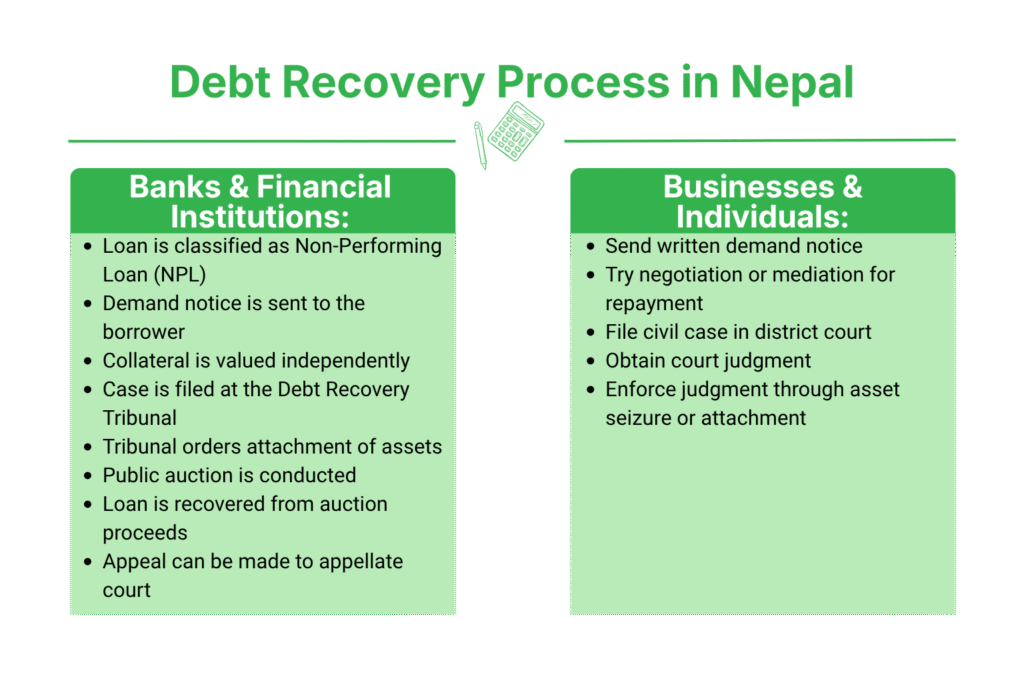
The debt recovery process in Nepal follows a structured legal path depending on the type of creditor.
For Banks and Financial Institutions:
- Loan Classification — The loan is classified as a Non-Performing Loan (NPL) as per NRB directives.
- Demand Notice — The bank issues a formal demand notice to the borrower requesting repayment.
- Collateral Valuation — The bank arranges for independent valuation of the pledged collateral.
- Filing Before the Debt Recovery Tribunal — If the borrower fails to respond, the bank files a petition before the Debt Recovery Tribunal.
- Attachment Order — The tribunal issues orders for attachment of the debtor’s assets.
- Public Auction — Attached collateral is sold through a public auction process.
- Recovery of Dues — Proceeds from the auction are used to recover the outstanding loan amount.
- Appeal — If either party is dissatisfied, they may appeal before the Debt Recovery Appellate Court.
For Businesses and Individuals:
- Issue a Written Demand Notice to the debtor.
- Negotiate a Repayment Plan through mediation or direct communication.
- File a Civil Case at the district court under the Civil Code, 2074.
- Obtain a Court Judgment in favor of recovery.
- Execute the Judgment through court-ordered property attachment or seizure.
Documents Required for Filing a Debt Recovery Case in Nepal
For Banks and Financial Institutions:
- Original loan agreement / credit facility agreement
- Promissory notes and guarantee agreements
- Collateral documents (land ownership certificates, property valuation reports)
- Statement of outstanding dues
- Demand notice copies with acknowledgment
- Board resolution authorizing the filing (for institutional creditors)
For Businesses and Individuals:
- Written loan agreement or promissory note
- Evidence of debt (bank transfers, receipts, invoices)
- Correspondence with the debtor
- Written demand notice with acknowledgment
- Witness statements (if applicable)
Table 1: Comparison of Debt Recovery Channels in Nepal
| Recovery Channel | Applicable Law | Jurisdiction | Time Frame | Best For |
|---|---|---|---|---|
| Debt Recovery Tribunal | Debt Recovery Tribunal Act, 2058 | Cases above NPR 5 million (Banks/FIs) | 6–18 months | Banks and Financial Institutions |
| District Civil Court | Civil Code, 2074 | All civil debt cases | 1–3 years | Individuals and Businesses |
| Nepal Rastra Bank Mediation | NRB Directives | Licensed bank disputes | Varies | Restructuring cases |
| Private Collection Agencies | Contract Law | All creditors | Varies | Pre-litigation recovery |
| Mediation / Arbitration | Mediation Act, 2068 | Agreed parties | 3–6 months | Commercial disputes |
Key Laws Governing Debt Recovery in Nepal
| Law | Year | Key Provision |
|---|---|---|
| Debt Recovery Tribunal Act, 2058 | 2002 | Establishes Debt Recovery Tribunal and Appellate Court |
| Bank and Financial Institution Act, 2073 | 2017 | Regulates banks and their recovery obligations |
| Civil Code of Nepal, 2074 | 2017 | Governs civil debt recovery between individuals/businesses |
| Insolvency Act, 2063 | 2007 | Handles insolvency and winding-up of indebted entities |
| Contract Act, 2056 | 2000 | Legal enforceability of debt agreements |
| Mediation Act, 2068 | 2011 | Alternative dispute resolution for debt matters |
Best Practices for Debt Recovery in Nepal
To improve the success rate of debt recovery in Nepal, creditors should follow these practices:
- Always execute a written agreement before extending credit or lending money.
- Register collateral properly with the relevant authority to ensure legal enforceability.
- Issue formal demand notices with written acknowledgment from the debtor before initiating legal action.
- Engage a qualified lawyer with experience in debt recovery and tribunal proceedings.
- File cases within the statute of limitations for individual debts, the window under the Civil Code is generally two years.
- Consider mediation as a cost-effective alternative before proceeding to full litigation.
- Maintain all correspondence records with the debtor as they serve as key evidence.
Role of Nepal Rastra Bank in Debt Recovery
The Nepal Rastra Bank (NRB) the central bank of Nepal plays a supervisory role in debt recovery. It:
- Issues directives on loan classification (pass, restructured, substandard, doubtful, and loss categories)
- Mandates provisioning requirements for NPLs
- Supervises banks’ recovery departments through on-site and off-site supervision
- Publishes data on NPLs and recovery performance
You can access NRB’s directives and publications at the official website: https://www.nrb.org.np
Debt Recovery Tribunal Nepal: Where and How to File Debt Recovery Case?
The Debt Recovery Tribunal Nepal has its bench in Kathmandu and handles cases filed by banks and financial institutions for recovery of loans and advances exceeding NPR 5 million.
The process to file before the Debt Recovery Tribunal:
- Prepare a recovery petition with all required documents.
- Submit the petition to the Tribunal registry along with the prescribed court fees.
- The tribunal issues a summons to the defendant.
- Hearings are conducted, and evidence is presented.
- The tribunal passes an order either for recovery, attachment, or dismissal.
- Appeals lie before the Debt Recovery Appellate Court.
For information on the Debt Recovery Tribunal, you may refer to the Supreme Court of Nepal’s official portal: https://supremecourt.gov.np
Challenges in Debt Recovery in Nepal
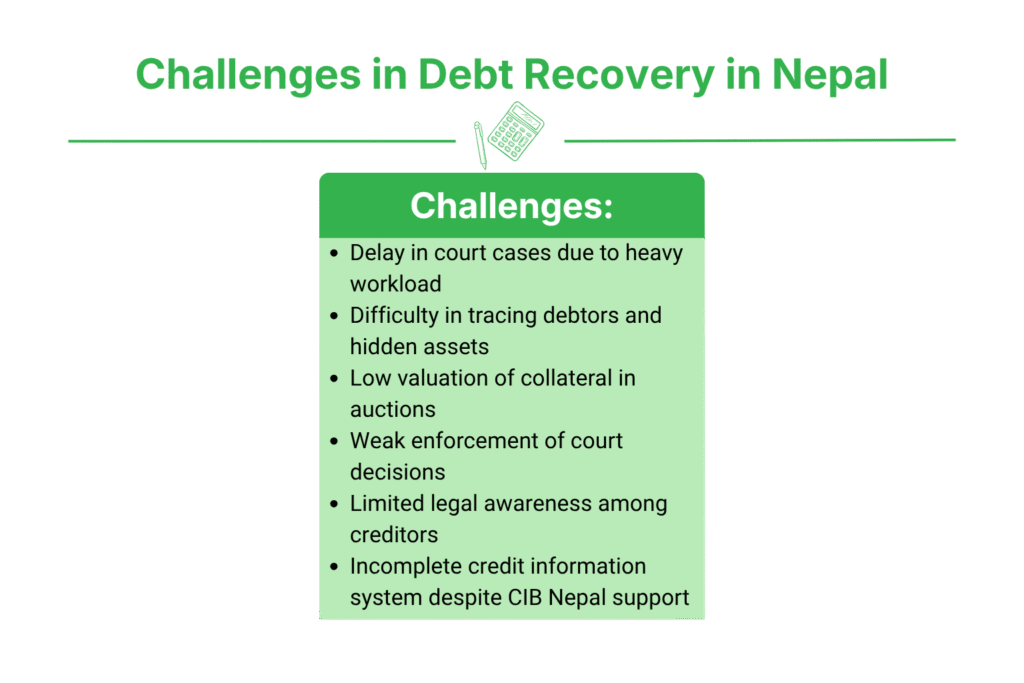
Debt recovery in Nepal faces several systemic challenges:
- Delays in court proceedings due to high caseloads
- Difficulty in locating debtors who have fled or transferred assets
- Undervaluation of collateral during auction processes
- Limited enforcement capacity of courts
- Lack of awareness among individual creditors about their legal rights
- Weak credit information systems though the Credit Information Bureau (CIB) Nepal provides some credit data, the system is not as comprehensive as in more developed markets
FAQs
1. What is the best debt recovery service in Nepal for banks?
The best debt recovery service for banks in Nepal is filing a case before the Debt Recovery Tribunal under the Debt Recovery Tribunal Act, 2058. This tribunal handles large bank loan defaults efficiently and has authority to attach property and order auctions.
2. Can an individual file a debt recovery case in Nepal?
Yes. An individual creditor can file a debt recovery case at the district civil court under the Civil Code of Nepal, 2074. The statute of limitations is generally two years from the date the debt became due.
3. How long does debt recovery take in Nepal?
Debt recovery through the Debt Recovery Tribunal typically takes 6 to 18 months. Civil court cases may take 1 to 3 years depending on case complexity and court schedule.
4. Is there an alternative to going to court for debt recovery in Nepal?
Yes. Mediation under the Mediation Act, 2068 (2011) is a recognized alternative. Parties can also negotiate repayment plans through private settlement, which is faster and less costly than litigation.
5. What documents are needed for a debt recovery case in Nepal?
Key documents include the original loan agreement, promissory notes, collateral documents, demand notice acknowledgment, outstanding balance statement, and any correspondence with the debtor. Additional documents may be required depending on the case type.
6. What is the role of Nepal Rastra Bank in debt recovery?
The Nepal Rastra Bank supervises licensed banks and financial institutions’ loan recovery activities, issues directives on NPL classification and provisioning, and ensures regulatory compliance. It does not directly recover loans but sets the framework within which banks operate. Visit https://www.nrb.org.np for more information.
Conclusion
Best Debt Recovery Service in Nepal depends largely on the type of creditor and the nature of the debt. Banks and financial institutions have the structured path of the Debt Recovery Tribunal under the Debt Recovery Tribunal Act, 2058, while individual creditors and businesses rely on the Civil Code, 2074 and district civil courts. Engaging a qualified debt recovery lawyer, maintaining proper documentation, and acting within the statute of limitations are the most effective steps any creditor can take. The legal framework in Nepal is well-defined, and using the right channel with the right professional support gives creditors the best chance of recovering their outstanding dues effectively.