

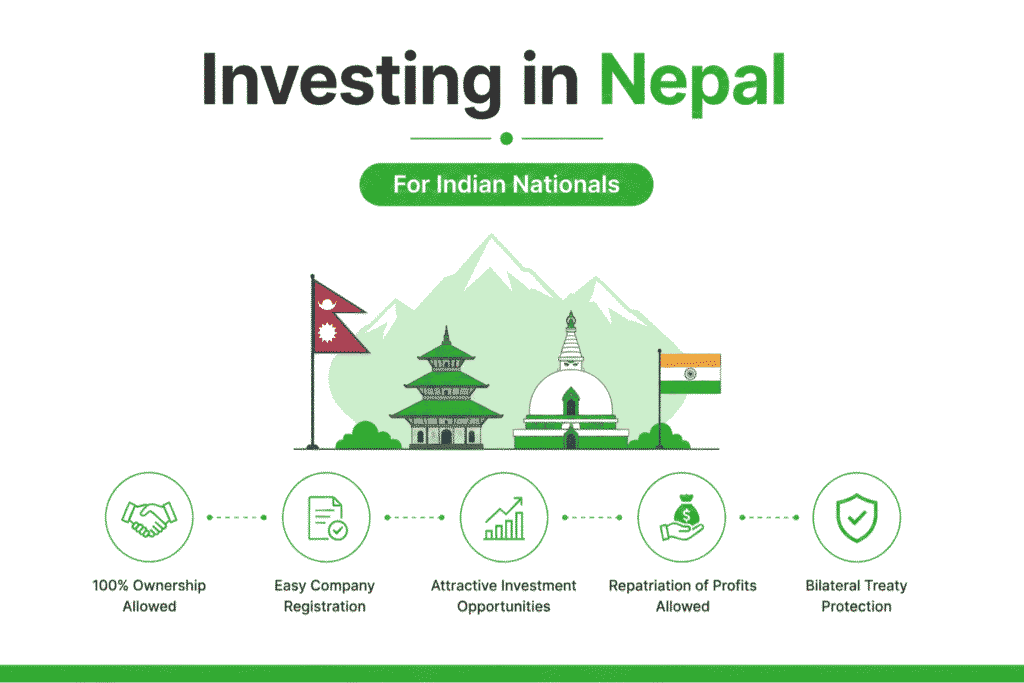
Investing in Nepal as an Indian national is a topic of growing interest given the deep economic and cultural ties between Nepal and India. Indian nationals represent one of the largest groups of foreign investors in Nepal. The legal framework governing foreign investment in Nepal applies to Indian nationals as well, though certain special provisions exist due to the unique bilateral relationship between the two countries. This article covers the legal basis, eligible sectors, restricted areas, required documents, and the step-by-step process for Indian nationals who want to invest in Nepal.
What Is the Legal Framework for Foreign Investment in Nepal?
The primary law governing foreign investment in Nepal is the Foreign Investment and Technology Transfer Act, 2019 (FITTA 2019). This act replaced the earlier FITTA of 1992 and introduced a more streamlined and investor-friendly system. Alongside FITTA 2019, the following laws are also relevant:
- Industrial Enterprises Act, 2020
- Companies Act, 2006 (amended)
- Nepal Rastra Bank Act, 2002
- Foreign Exchange (Regulation) Act, 1962
- Income Tax Act, 2002
Indian nationals fall under the category of “foreign investor” as defined in FITTA 2019. Section 2(c) of FITTA 2019 defines a foreign investor as a foreign individual, firm, company, or institution that invests in Nepal. This includes Indian citizens and Indian-registered companies.
The Department of Industry (DoI) under the Ministry of Industry, Commerce and Supplies is the primary regulatory body for registering and approving foreign investment in Nepal. The Nepal Rastra Bank (NRB) regulates the inflow and outflow of foreign currency related to investment.
Can Indian Nationals Invest in Nepal?
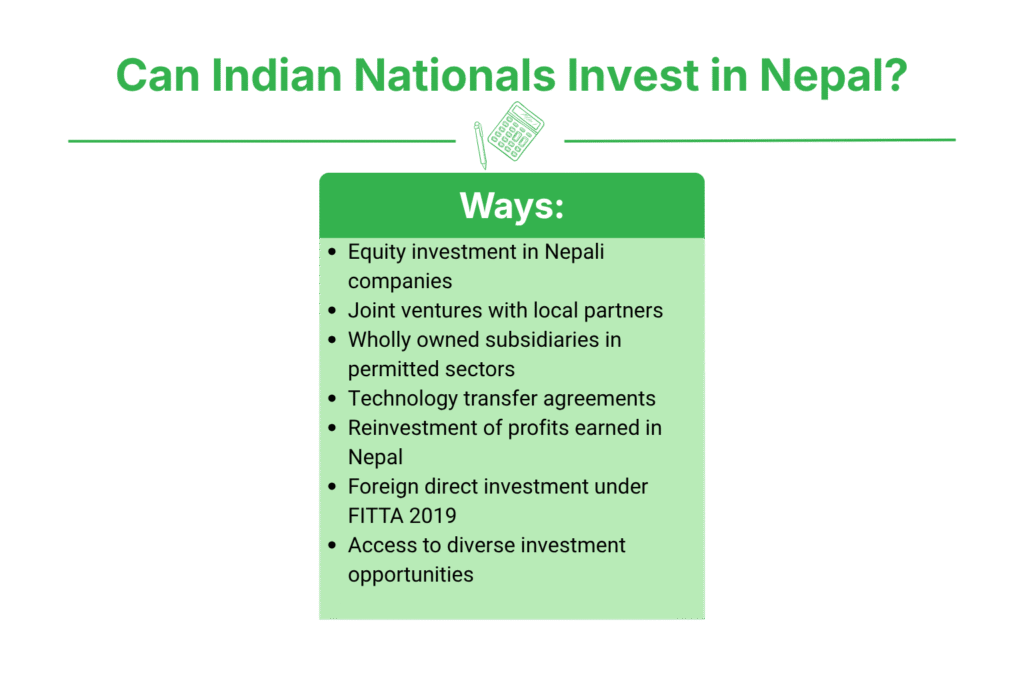
Yes, Indian nationals can invest in Nepal. Under FITTA 2019, Indian nationals are eligible to make foreign direct investment (FDI) in Nepal. The Nepal government actively encourages Indian investment given the geographical proximity, shared borders, and longstanding economic relations between Nepal and India.
Indian nationals can invest through:
- Equity participation in Nepali companies
- Joint ventures with Nepali partners
- Wholly owned subsidiaries (in sectors where 100% foreign ownership is permitted)
- Technology transfer agreements
- Reinvestment of profits earned in Nepal
The Nepal-India Friendship Treaty of 1950 and bilateral trade agreements further facilitate Indian investment in Nepal by providing Indian nationals treatment at par with Nepali nationals in many economic activities.
What Are the Eligible Sectors for Indian Investment in Nepal?
Indian nationals can invest across a wide range of sectors in Nepal. The government of Nepal has identified priority sectors to attract foreign direct investment.
| Sector | Foreign Ownership Allowed |
|---|---|
| Hydropower and Energy | Up to 100% |
| Manufacturing Industries | Up to 100% |
| Tourism and Hospitality | Up to 100% (with conditions) |
| Information Technology | Up to 100% |
| Education (Higher Level) | Up to 51% |
| Healthcare and Hospitals | Up to 100% |
| Agriculture (specific areas) | Up to 100% |
| Infrastructure Development | Up to 100% |
| Banking and Finance | As per Nepal Rastra Bank directives |
The Investment Board Nepal (IBN) handles large-scale investments above NPR 6 billion (approximately INR 3.75 billion). For investments below this threshold, the Department of Industry handles approvals.
What Are the Restricted Sectors for Indian Nationals?
Not all sectors are open to foreign investment in Nepal. The Government of Nepal has issued a Negative List under FITTA 2019 that restricts or prohibits foreign investment in certain sectors.
Sectors where Indian nationals cannot invest or face restrictions include:
- Cottage and small industries defined under the Industrial Enterprises Act
- Personal service businesses (such as hair salons, tailoring shops)
- Arms, ammunition, and explosives manufacturing
- Currency printing and minting
- Real estate business (buying and selling land)
- Retail trading (except where permitted through specific policies)
- Poultry farming and fisheries at small scale
- Travel agencies (below prescribed capital threshold)
- Security printing
Indian nationals must verify the current negative list published by the Department of Industry before initiating an investment proposal. The list is periodically revised through Government of Nepal Cabinet decisions.
What Is the Minimum Investment Requirement for Indian Nationals?
Under FITTA 2019, the minimum foreign investment amount required is NPR 20 million (approximately INR 12.5 million). This applies to Indian nationals as well.
However, investment in certain sectors may have different minimum thresholds set by sector-specific regulations. For example:
- Foreign investment in banking requires compliance with Nepal Rastra Bank directives
- Investment in hydropower projects requires compliance with the Electricity Act and Energy Policy
- Investment in the education sector requires approval from the University Grants Commission
The capital must be brought through banking channels and must be approved and verified by Nepal Rastra Bank. Cash transfers outside banking channels are not accepted as valid foreign investment.
What Documents Are Required for Indian Nationals to Invest in Nepal?
Indian nationals must submit the following documents to the Department of Industry or Investment Board Nepal:
For Individual Indian Investors:
- Copy of valid Indian passport (all pages)
- Copy of PAN card (India) or equivalent tax identification
- Bank statement showing financial capacity (last 6 months)
- Business proposal and project report
- Curriculum Vitae (CV) of the investor
- Police clearance certificate from India
- Recommendation letter (if applicable)
For Indian Companies Investing in Nepal:
- Certificate of incorporation from the Registrar of Companies, India
- Memorandum and Articles of Association
- Board resolution authorizing investment in Nepal
- Financial statements (audited) for the last 3 years
- Tax clearance certificate from Indian tax authorities
- PAN/TAN registration documents
- Bank reference letter
For Company Registration in Nepal:
- Application form at the Office of Company Registrar (OCR)
- Draft Memorandum of Association and Articles of Association
- Proof of registered office address in Nepal
- Foreign investment approval letter from DoI
- NRB approval for foreign currency inflow
What Is the Step-by-Step Process for Indian Nationals to Invest in Nepal?
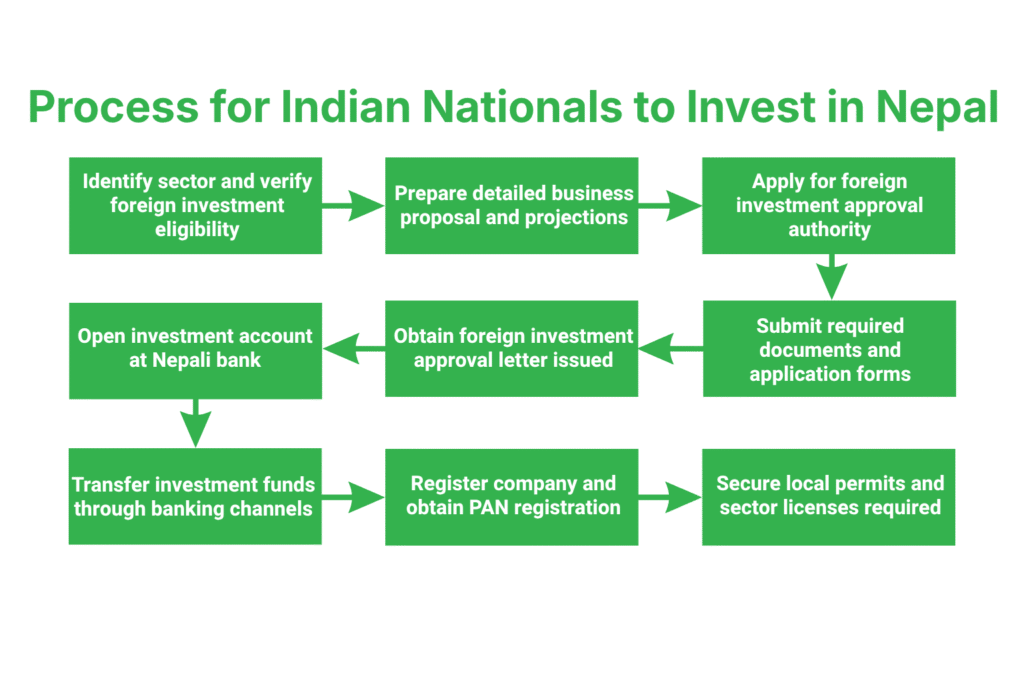
The process of registering a foreign investment in Nepal involves multiple regulatory bodies. Below is the step-by-step process:
- Identify the business sector and verify it is not in the negative list
- Prepare a detailed project/business proposal with financial projections
- Apply for Foreign Investment Approval at the Department of Industry (DoI) or Investment Board Nepal (IBN) depending on investment size
- Submit all required documents as per DoI/IBN requirements
- Receive Foreign Investment Approval Letter from DoI or IBN
- Open a foreign investment account at a commercial bank in Nepal approved by Nepal Rastra Bank
- Remit the investment amount from India through banking channels (SWIFT transfer)
- Obtain NRB approval for inward remittance of investment funds
- Register the company at the Office of Company Registrar (OCR) in Nepal
- Obtain PAN registration from the Inland Revenue Department (IRD) of Nepal
- Register with the concerned Municipality for local business license
- Obtain sector-specific licenses (e.g., tourism license, health license, etc.)
The DoI operates a One Stop Service Center (OSSC) to facilitate foreign investors by providing multiple services at a single location.
Official website: Department of Industry Nepal
What Are the Tax Provisions for Indian Investors in Nepal?
Indian investors in Nepal are subject to the Income Tax Act, 2002 of Nepal. The following tax rates and provisions apply:
| Tax Type | Rate / Provision |
|---|---|
| Corporate Income Tax (General) | 25% |
| Corporate Income Tax (Manufacturing) | 20% |
| Dividend Tax (repatriated) | 5% |
| Capital Gains Tax | 10–15% depending on nature |
| Value Added Tax (VAT) | 13% |
| Withholding Tax on Interest | 15% |
| Tax Holiday (New Industries, specific areas) | Up to 10 years |
Nepal and India have a Double Taxation Avoidance Agreement (DTAA) signed on October 27, 1987. This agreement prevents Indian investors from being taxed twice, once in Nepal and once in India , on the same income. Under the DTAA, tax credits are available and withholding tax rates on dividends and royalties are reduced.
Indian investors can repatriate profits, dividends, and capital after paying applicable taxes in Nepal. Repatriation is done through Nepal Rastra Bank-approved foreign exchange transactions.
What Are the Repatriation Rights for Indian Nationals?
Under FITTA 2019, foreign investors including Indian nationals have the legal right to repatriate the following amounts after fulfilling all tax and legal obligations:
- Profit and dividend earned from investment
- Proceeds from the sale of shares or assets
- Principal amount of the original investment
- Amounts received through technology transfer fees and royalties
- Compensation received in case of acquisition or nationalization
The repatriation must be made through Nepal Rastra Bank-approved commercial banks in Nepal. The process requires submission of tax clearance certificate, audited financial statements, and proof of the investment amount originally remitted.
What Role Does the Investment Board Nepal Play?
The Investment Board Nepal (IBN) was established under the Investment Board Act, 2011. IBN handles investments above NPR 6 billion and acts as the one-stop agency for large infrastructure projects including hydropower, airports, roads, industrial parks, and special economic zones.
For Indian investors considering large-scale investment in Nepal, IBN provides:
- Project facilitation and coordination
- Land acquisition assistance
- Regulatory approvals across ministries
- Post-investment support and dispute resolution facilitation
Official website: Investment Board Nepal
What Are the Common Challenges Indian Investors Face in Nepal?
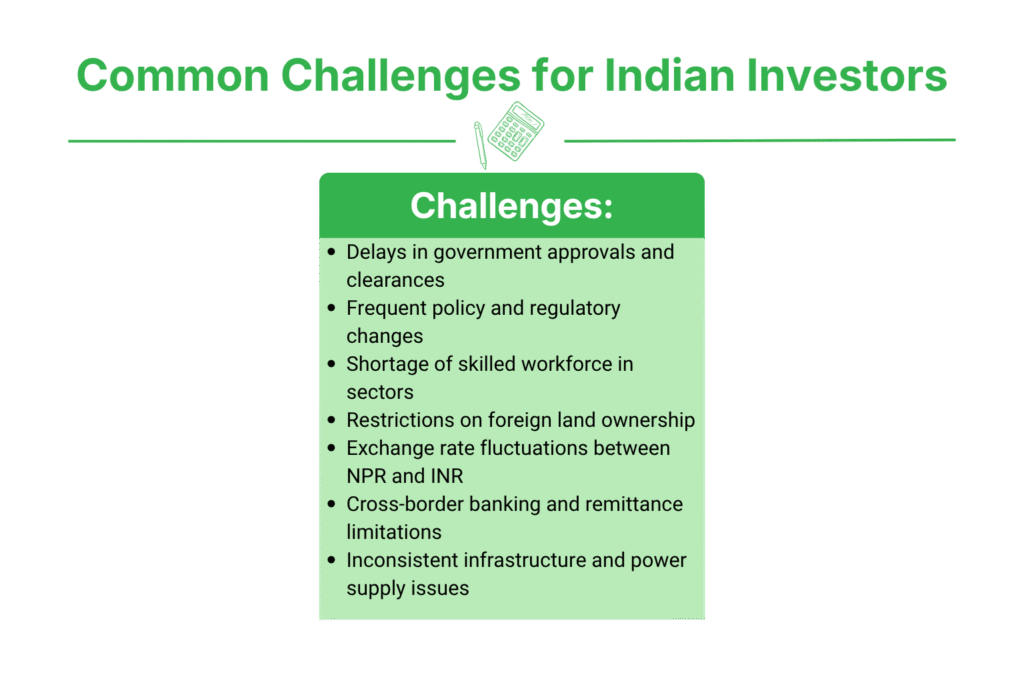
Indian nationals investing in Nepal may encounter the following practical challenges:
- Delay in regulatory approvals across multiple government departments
- Frequent policy changes and unclear sector-specific regulations
- Limited availability of skilled labor in some sectors
- Land acquisition restrictions (foreigners cannot own land in Nepal)
- Exchange rate fluctuation between NPR and INR
- Banking limitations for cross-border fund transfers
- Electricity supply inconsistency in certain regions
The Government of Nepal has been making efforts to reduce these barriers through the Business Environment Reform Program and by updating the Foreign Investment Policy periodically.
FAQs
1. Can an Indian national own 100% of a company in Nepal?
Yes, Indian nationals can own 100% equity in certain sectors such as manufacturing, IT, and hydropower. However, in sectors like education and some service industries, ownership is capped at 51% as per FITTA 2019 and sector-specific regulations.
2. Is there a minimum investment amount for Indian nationals in Nepal?
Yes, the minimum foreign investment amount under FITTA 2019 is NPR 20 million (approximately INR 12.5 million). Sector-specific minimum thresholds may also apply depending on the nature of the business.
3. Can Indian nationals buy land in Nepal for business purposes?
No, foreign nationals including Indian citizens cannot purchase land in Nepal. However, they can lease land for business purposes for periods up to 50 years as per the Industrial Enterprises Act, 2020.
4. Does Nepal have a Double Taxation Avoidance Agreement with India?
Yes, Nepal and India signed a DTAA on October 27, 1987. This agreement prevents double taxation on income earned by Indian investors in Nepal and provides reduced withholding tax rates on dividends and royalties.
5. Which government body approves foreign investment in Nepal?
The Department of Industry (DoI) approves investments below NPR 6 billion. The Investment Board Nepal (IBN) handles investments above NPR 6 billion. Nepal Rastra Bank regulates all foreign currency-related transactions.
6. Can Indian nationals repatriate profits from Nepal?
Yes, Indian nationals can repatriate profits, dividends, and original investment capital from Nepal. Repatriation requires tax clearance and must be processed through Nepal Rastra Bank-approved commercial banks.
Conclusion
Investing in Nepal as an Indian national is legally permitted and supported by both bilateral agreements and domestic laws like FITTA 2019. The investment process involves regulatory approvals from the Department of Industry or Investment Board Nepal, company registration at the Office of Company Registrar, and foreign currency clearance from Nepal Rastra Bank. Indian investors must comply with the negative list, minimum investment thresholds, and applicable tax laws. The Nepal-India DTAA provides added protection against double taxation. Indian nationals considering investment in Nepal should conduct thorough legal and financial due diligence and engage qualified local legal and tax advisors to ensure compliance with all applicable Nepali laws.