
Confidentiality Agreement Drafting Service in Nepal has become an essential legal requirement for businesses, entrepreneurs, and individuals who share sensitive information with third parties. A confidentiality agreement, also commonly known as a Non-Disclosure Agreement (NDA), is a legally binding contract that restricts the disclosure of confidential information shared between parties. In Nepal, the demand for professional confidentiality agreement drafting service has grown significantly due to expanding business activities, foreign investment, technology partnerships, and corporate collaborations.
What Is a Confidentiality Agreement?
A confidentiality agreement is a written legal contract between two or more parties that defines what information must be kept private and restricts its disclosure to unauthorized persons. It establishes the terms under which confidential information is shared and the consequences of its unauthorized disclosure.
In Nepal, confidentiality agreements are governed primarily under:
- Contract Act, 2056 (2000) – The primary law governing contractual obligations in Nepal
- Company Act, 2063 (2006) – Relevant for corporate confidentiality provisions
- Industrial Enterprises Act, 2076 (2020) – Covers trade secrets and business information
- Labour Act, 2074 (2017) – Applicable for employee confidentiality obligations
- Copyright Act, 2059 (2002) – For protection of intellectual property
A valid confidentiality agreement in Nepal must satisfy the basic requirements of a valid contract under Section 522 of the Contract Act, 2056, including offer, acceptance, lawful consideration, and the capacity of parties.
Why Do You Need a Confidentiality Agreement in Nepal?
Businesses and individuals in Nepal need a properly drafted confidentiality agreement to protect their proprietary information. Without a formal NDA, there is no legal mechanism to prevent a party from disclosing trade secrets, business strategies, financial data, or technical information to competitors or the public.
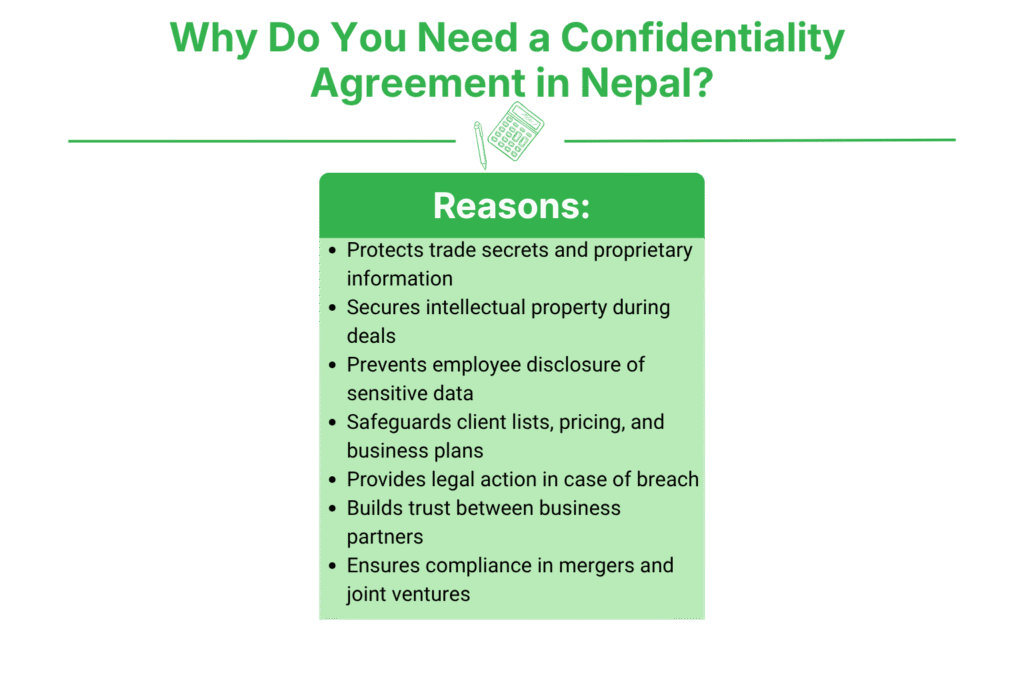
Key reasons to have a confidentiality agreement in Nepal include:
- Protection of trade secrets and proprietary business information
- Safeguarding intellectual property during negotiations or partnerships
- Restricting employees from disclosing sensitive company data
- Protecting client lists, pricing strategies, and business plans
- Establishing legal remedies in case of breach
- Building trust between business partners during collaborations
- Ensuring legal compliance during mergers, acquisitions, and joint ventures
Types of Confidentiality Agreements in Nepal
Professional confidentiality agreement drafting service in Nepal covers several types of NDA structures depending on the nature of the business relationship.
| Type of NDA | Description | Common Use |
|---|---|---|
| Unilateral NDA | One party discloses information to another | Employer–employee agreements |
| Bilateral NDA | Both parties share confidential information | Business partnerships, joint ventures |
| Multilateral NDA | Three or more parties involved | Corporate mergers, multi-party deals |
| Employee NDA | Restricts employees from disclosing company secrets | Employment contracts |
| Vendor / Supplier NDA | Restricts vendors from sharing client information | Outsourcing and procurement |
| Pre-employment NDA | Signed before sharing company information with a candidate | Recruitment process |
Essential Elements of a Confidentiality Agreement in Nepal
A well-drafted confidentiality agreement in Nepal must contain specific legally required clauses. The absence of any critical clause can render the agreement unenforceable or create loopholes.
1. Identification of the Parties
The agreement must clearly identify the disclosing party (the one sharing confidential information) and the receiving party (the one who receives and must protect the information). Full legal names, addresses, and registration numbers (for companies) must be mentioned.
2. Definition of Confidential Information
The agreement must precisely define what constitutes “confidential information.” This includes trade secrets, financial records, technical data, customer lists, business plans, formulas, and any proprietary data. The more specific the definition, the stronger the legal protection.
3. Obligations of the Receiving Party
The receiving party must clearly agree to:
- Keep the information strictly confidential
- Use the information only for the stated purpose
- Not share the information with third parties without prior written consent
- Take reasonable measures to prevent unauthorized disclosure
4. Exclusions from Confidentiality
A legally sound NDA must state what information is NOT considered confidential, such as:
- Information already known to the public
- Information independently developed by the receiving party
- Information disclosed by a third party without restriction
- Information required to be disclosed by law or court order
5. Duration and Term
The agreement must specify for how long the confidentiality obligation remains in force. In Nepal, confidentiality obligations in employment NDAs typically range from 2 to 5 years after the termination of the relationship, while business NDAs may last longer.
6. Remedies and Consequences of Breach
The agreement should clearly outline remedies in case of breach, including:
- Injunctive relief (court order to stop the breach)
- Monetary damages and compensation
- Specific performance orders
- Termination of the business relationship
7. Governing Law and Jurisdiction
The agreement must state that it is governed by the laws of Nepal and specify the jurisdiction for dispute resolution, typically the courts of Nepal or an agreed arbitration forum under the Arbitration Act, 2055 (1999).
8. Signatures and Notarization
All parties must sign the agreement. For added legal enforceability, confidentiality agreements in Nepal are often notarized at the Office of the District Administration or before a certified legal practitioner registered with the Nepal Bar Association.
Confidentiality Agreement Drafting Process in Nepal
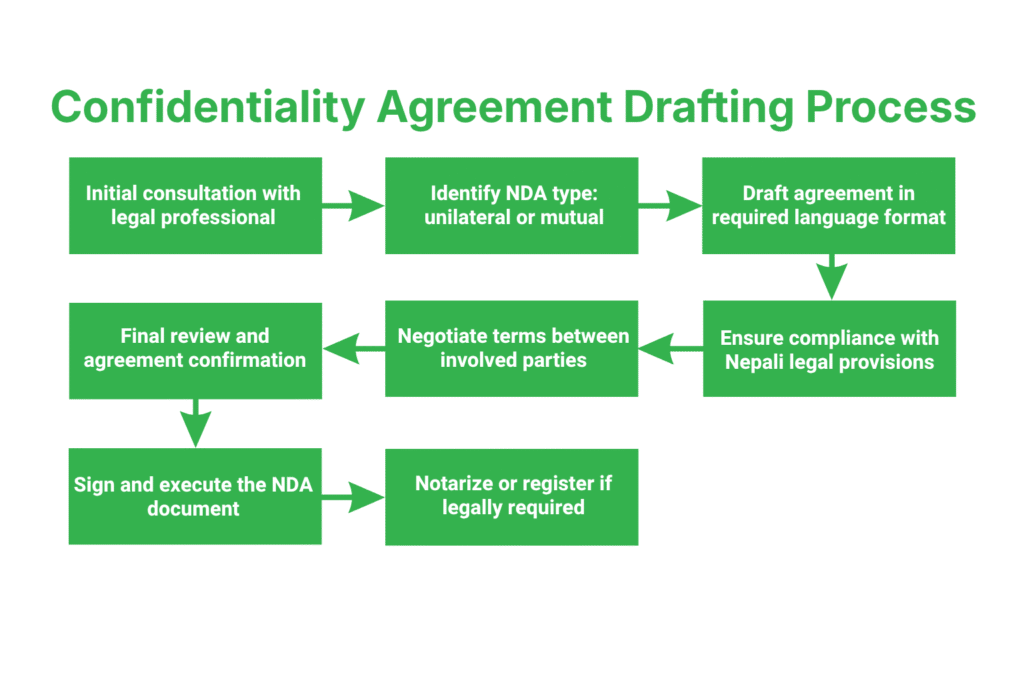
The process of professionally drafting a confidentiality agreement in Nepal involves the following steps:
- Step 1: Initial consultation with a legal expert to understand the nature of information and the relationship between parties
- Step 2: Identification of the type of NDA required (unilateral, bilateral, or multilateral)
- Step 3: Drafting the agreement in Nepali or English (or bilingual format as required)
- Step 4: Review of all clauses for legal compliance under Nepali law
- Step 5: Negotiation of terms between the parties if required
- Step 6: Finalization and signing of the agreement by all parties
- Step 7: Notarization or attestation of the document as needed
- Step 8: Registration if required under applicable company or commercial laws
Documents Required for Drafting a Confidentiality Agreement in Nepal
The following documents are typically required when availing confidentiality agreement drafting service in Nepal:
- Citizenship certificate or passport of individual parties
- Company registration certificate (for corporate parties)
- PAN/VAT registration certificate
- Memorandum and Articles of Association (for companies)
- Board resolution authorizing a representative to sign (for companies)
- Details of the nature of confidential information to be protected
- Previous agreements between the parties (if any)
- Any relevant intellectual property registration certificates
Confidentiality Agreement for Employees in Nepal
Employee confidentiality agreements are among the most commonly drafted NDAs in Nepal. Under the Labour Act, 2074 (2017), employers can impose reasonable restrictions on employees to protect trade secrets and business information. These agreements are often included as a clause in the employment contract or signed separately.
Key provisions in an employee confidentiality agreement in Nepal include:
- Prohibition on sharing company data during and after employment
- Non-compete restrictions (subject to reasonableness under Contract Act)
- Prohibition on soliciting company clients or employees after resignation
- Ownership of intellectual property created during employment
- Remedies for breach including compensation for damages
Employers must ensure that these restrictions are reasonable in scope, duration, and geographic coverage, as overly broad restrictions may be considered unenforceable under Nepalese contract law.
Confidentiality Agreements for Foreign Investment and Joint Ventures in Nepal
With the growth of foreign direct investment in Nepal under the Foreign Investment and Technology Transfer Act, 2075 (2019) and the Department of Industry, confidentiality agreements have become standard practice in joint ventures, technology transfer agreements, and foreign business partnerships.
Foreign investors frequently require NDAs to protect:
- Proprietary technology and processes
- Market entry strategies
- Financial projections and business plans
- Partnership terms before final deal closure
| Scenario | Type of NDA | Key Consideration |
|---|---|---|
| Foreign–Local Joint Venture | Bilateral NDA | Protect business strategy of both parties |
| Technology Transfer | Unilateral NDA | Protect foreign company’s IP |
| Merger and Acquisition | Multilateral NDA | Protect due diligence information |
| Software Development | Unilateral / Bilateral NDA | Protect source code and technical data |
| Employment in MNC | Employee NDA | Protect global trade secrets |
Legal Enforcement of Confidentiality Agreements in Nepal
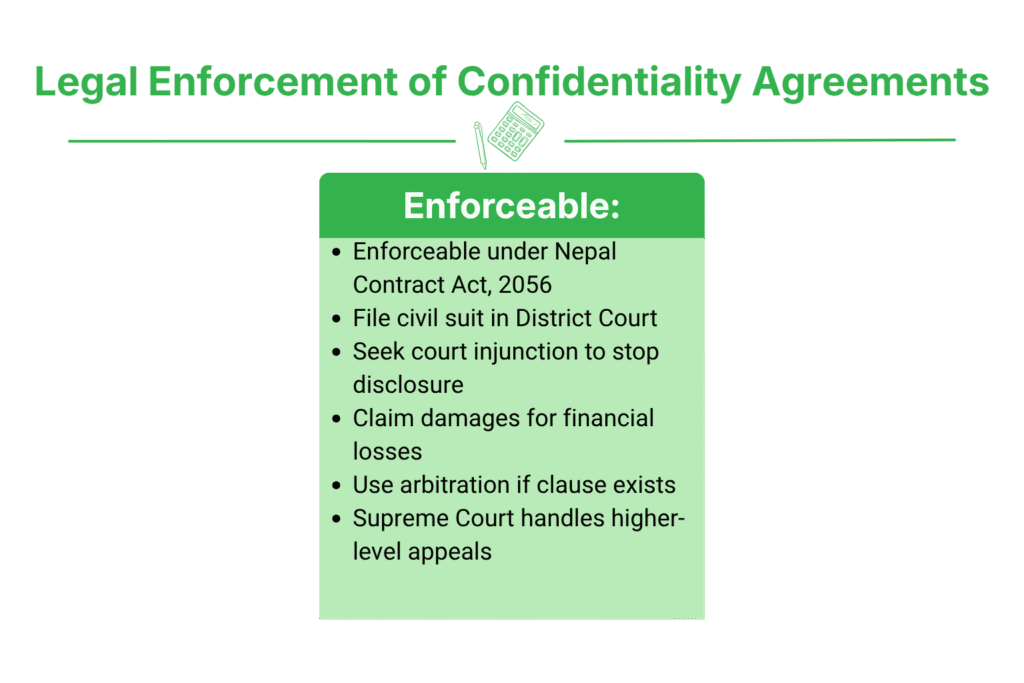
A confidentiality agreement in Nepal is enforceable under the Contract Act, 2056. In case of breach, the aggrieved party can:
- File a civil lawsuit before the District Court for damages and compensation
- Seek an injunction from the court to prevent further disclosure
- Claim damages for actual losses caused by the breach
- Refer the dispute to arbitration if an arbitration clause is included in the agreement
The Supreme Court of Nepal has upheld the enforceability of confidentiality agreements where the terms were clear, reasonable, and complied with by both parties at the time of signing.
Cost of Confidentiality Agreement Drafting Service in Nepal
The cost of professional confidentiality agreement drafting service in Nepal varies depending on the complexity of the agreement, the nature of the business, and the law firm or legal professional engaged. Generally:
- Simple/Standard NDA: NPR 5,000 to NPR 15,000
- Complex Business NDA (Bilateral/Multilateral): NPR 15,000 to NPR 50,000
- Corporate-Level NDA for Foreign Investment: NPR 50,000 to NPR 2,00,000+
Notarization fees and government charges are separate from professional legal fees.
FAQs
1. Is a confidentiality agreement legally binding in Nepal?
Yes. A confidentiality agreement is legally binding in Nepal under the Contract Act, 2056, provided it meets all conditions of a valid contract including free consent, lawful object, and the capacity of parties to contract.
2. Can a confidentiality agreement be enforced against an employee who has resigned?
Yes. A confidentiality agreement can be enforced against a former employee in Nepal if the restriction is reasonable in scope, duration, and is supported by lawful consideration under the Labour Act, 2074.
3. Does a confidentiality agreement need to be notarized in Nepal?
Notarization is not mandatory for all confidentiality agreements but is strongly recommended. Notarization adds legal weight to the document and makes enforcement easier before Nepali courts and government authorities.
4. What language should a confidentiality agreement be written in Nepal?
Confidentiality agreements in Nepal can be drafted in Nepali, English, or both. For government submissions and court proceedings, a Nepali version or certified Nepali translation is generally required under Nepal’s official language policy.
5. How long can a confidentiality obligation last in Nepal?
There is no fixed statutory limit, but courts in Nepal generally enforce confidentiality obligations that are reasonable in duration. Employment NDAs typically last 2–5 years, while business NDAs may extend indefinitely for trade secrets.
6. What happens if a party breaches a confidentiality agreement in Nepal?
The aggrieved party can file a civil suit for damages before the District Court, seek an injunction, or initiate arbitration proceedings. Under the Contract Act, 2056, the breaching party is liable to compensate for all losses resulting from the breach.
Conclusion
Confidentiality agreement drafting service in Nepal is a vital legal service that protects sensitive business information, trade secrets, and proprietary data shared between parties in a business relationship. A properly drafted NDA, compliant with the Contract Act, 2056, Labour Act, 2074, and other applicable Nepalese laws, provides enforceable legal protection and builds trust between business partners. Engaging a qualified legal professional for confidentiality agreement drafting in Nepal ensures that all essential clauses are included, the terms are legally sound, and your interests are fully protected under Nepali law. For further guidance, you can refer to the Nepal Law Commission and the Office of the Attorney General of Nepal.