
Money exchange license in Nepal is a formal authorization issued by Nepal Rastra Bank (NRB) that permits a business entity to legally conduct foreign currency exchange operations within the country. Obtaining a money exchange license in Nepal requires following a structured regulatory process governed by specific laws and directives issued by the central bank. This article covers How to Obtain Money Exchange License in Nepal, the complete process, eligibility criteria, required documents, capital requirements, and regulatory framework for money exchange license in Nepal.
What Is a Money Exchange License in Nepal?
A money exchange license in Nepal is an official permit that allows a registered company or institution to buy and/or sell foreign currencies in exchange for Nepalese Rupees (NPR). The license is issued by Nepal Rastra Bank, the central monetary authority of Nepal.
Foreign exchange business in Nepal operates under the provisions of the Foreign Exchange (Regulation) Act, 2019 (2076 B.S.) and the Nepal Rastra Bank Act, 2002 (2058 B.S.). Any individual or entity conducting money exchange services without a valid license from NRB is subject to legal penalties under these laws.
Nepal Rastra Bank’s Foreign Exchange Management Department (FEMD) is the designated department responsible for processing, issuing, renewing, and canceling money exchange licenses.
Types of Money Exchange Licenses in Nepal
Nepal Rastra Bank issues two main categories of money exchange licenses in Nepal based on the scope of permitted operations.
| License Type | Permitted Activity | Minimum Paid-Up Capital |
|---|---|---|
| Full-Fledged Money Changer (FFMC) | Buy and Sell foreign currencies | NPR 2 Crore (20 Million) |
| Restricted Money Changer (RMC) | Buy foreign currencies only | NPR 50 Lakh (5 Million) |
Full-Fledged Money Changer (FFMC)
A Full-Fledged Money Changer license allows the licensed entity to both purchase and sell foreign currencies against Nepalese Rupees. FFMC license holders can operate exchange counters at airports, hotels, commercial areas, and tourist destinations.
Restricted Money Changer (RMC)
A Restricted Money Changer license permits the entity to only purchase foreign currencies from tourists and foreign visitors. They cannot sell foreign currency. These are typically found in hotels, travel agencies, and tourist areas.
Legal Framework Governing Money Exchange License in Nepal
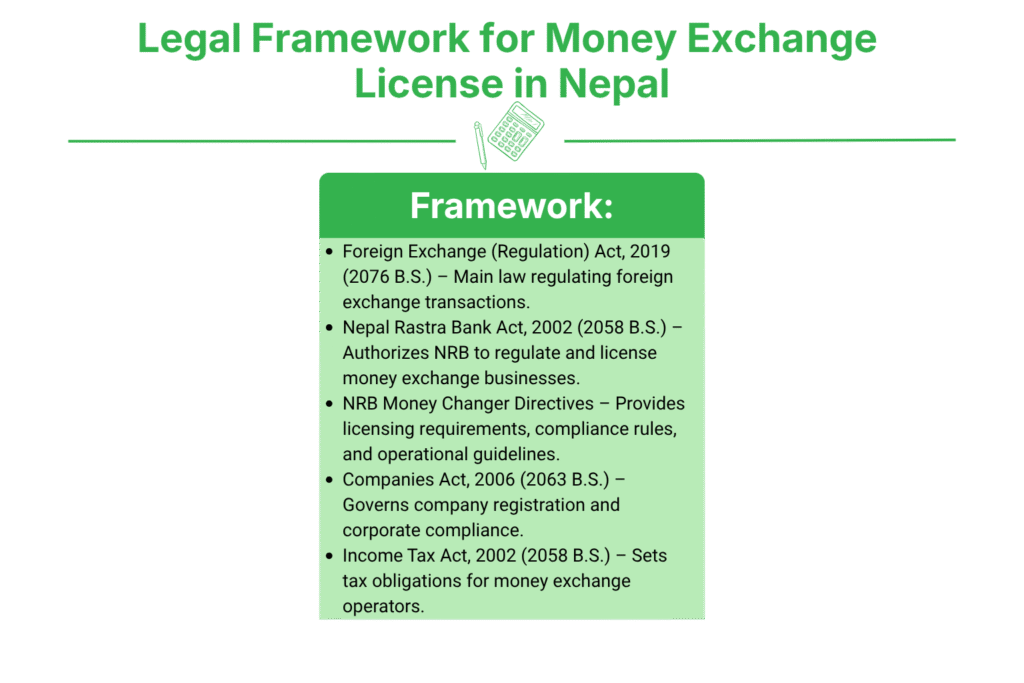
Money exchange business in Nepal operates under a well-defined legal structure. The key laws and regulations include:
- Foreign Exchange (Regulation) Act, 2019 (2076 B.S.) — The primary law governing all foreign exchange transactions in Nepal.
- Nepal Rastra Bank Act, 2002 (2058 B.S.) — Empowers NRB to regulate monetary and foreign exchange operations.
- Money Changer Directives issued by NRB — Detailed procedural guidelines for obtaining and maintaining a money exchange license.
- Company Act, 2006 (2063 B.S.) — Governs the registration of the company seeking the license.
- Income Tax Act, 2002 (2058 B.S.) — Tax obligations of money exchange businesses.
Who Can Apply for a Money Exchange License in Nepal?
Not every entity is eligible to apply for a money exchange license in Nepal. Nepal Rastra Bank has set specific eligibility criteria:
- The applicant must be a Private Limited Company or Public Limited Company registered under the Company Act, 2006.
- The company’s memorandum of association (MOA) must clearly mention foreign exchange business as an objective.
- The company must meet the minimum paid-up capital requirements as prescribed by NRB.
- The promoters and directors must have a clean financial record with no history of fraud, default, or blacklisting.
- The proposed business premises must meet NRB’s prescribed standards and be located in areas approved for foreign exchange operations.
- Foreign nationals can be shareholders, but majority ownership by Nepali citizens may be required depending on the type of license.
Documents Required for Money Exchange License in Nepal
The following documents are required when applying for a money exchange license in Nepal:
Company Registration Documents
- Certificate of Incorporation from the Office of the Company Registrar (OCR)
- Memorandum of Association (MOA) and Articles of Association (AOA)
- PAN/VAT Registration Certificate
- Tax Clearance Certificate
Promoters and Directors Documents
- Citizenship certificates of all promoters and directors
- Academic and professional qualification certificates
- Personal financial statements and bank statements
- Declaration of no criminal or financial default record
- Photographs of all directors
Financial Documents
- Proof of paid-up capital (bank certificate confirming capital deposit)
- Audited financial statements (if the company was previously operating)
- Share structure and shareholding pattern
Business Premises Documents
- Ownership certificate or rental agreement for the business premises
- Layout and floor plan of the proposed exchange counter
- Photographs of the business location
Application-Specific Documents
- Duly filled application form as prescribed by NRB
- Business plan describing the proposed money exchange operations
- Security arrangements for the premises (CCTV, vault, etc.)
- Anti-Money Laundering (AML) and Know Your Customer (KYC) policy document
Step-by-Step Process to Obtain Money Exchange License in Nepal
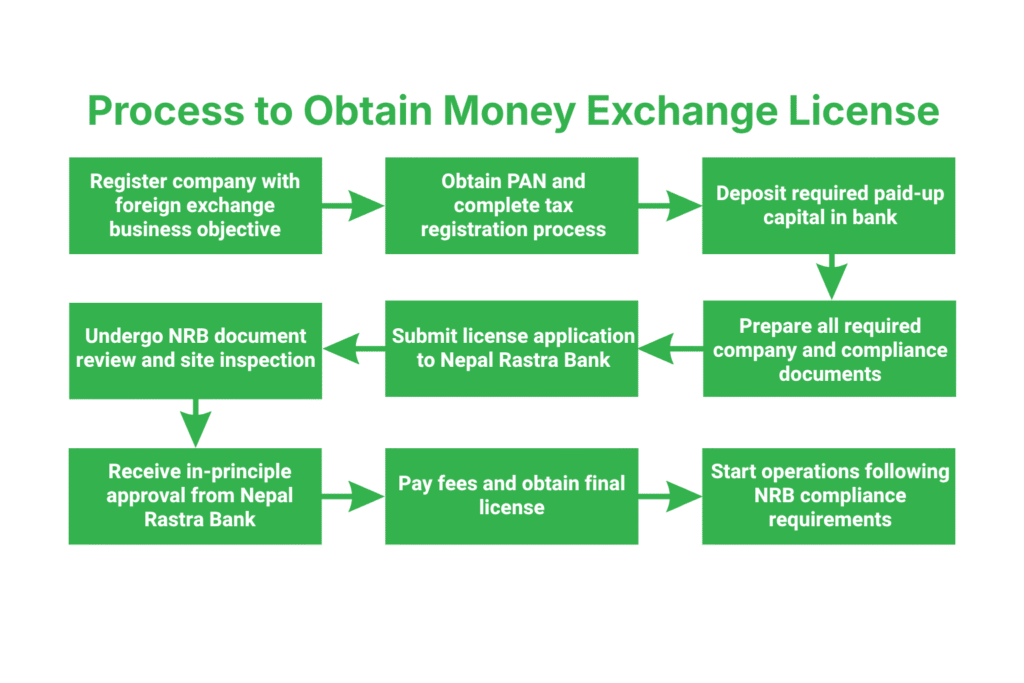
The process to obtain a money exchange license in Nepal involves multiple stages. Below is the step-by-step process:
Step 1: Register a Company
Register a private or public limited company at the Office of the Company Registrar (OCR) with foreign exchange business as a stated objective in the MOA. Visit OCR Nepal for company registration.
Step 2: Obtain PAN and Tax Registration
After company registration, obtain a Permanent Account Number (PAN) from the Inland Revenue Department. Visit IRD Nepal for PAN registration.
Step 3: Deposit Minimum Paid-Up Capital
Deposit the required minimum paid-up capital in a bank account in the company’s name and obtain a bank certificate confirming the capital deposit.
Step 4: Prepare Required Documents
Compile all documents listed above including company registration documents, promoter documents, financial documents, business plan, AML/KYC policy, and premises documents.
Step 5: Submit Application to Nepal Rastra Bank
Submit the duly filled application form along with all required documents to the Foreign Exchange Management Department (FEMD) of Nepal Rastra Bank. Visit Nepal Rastra Bank for official forms and guidelines.
Step 6: NRB Verification and Site Inspection
NRB officials will review the submitted documents and conduct a site inspection of the proposed business premises to verify the physical infrastructure, security arrangements, and compliance with prescribed standards.
Step 7: In-Principle Approval
After satisfactory verification, NRB may issue an in-principle approval letter to the applicant, subject to fulfillment of additional conditions if any.
Step 8: Final License Issuance
Upon completion of all requirements and payment of the prescribed license fee, NRB issues the official money exchange license. The license specifies the type (FFMC or RMC) and the authorized location.
Step 9: Commence Operations
After receiving the license, the company can commence money exchange operations, subject to compliance with all NRB directives on reporting, AML/CFT measures, and record-keeping.
License Fees and Renewal for Money Exchange License in Nepal
| Particulars | Full-Fledged Money Changer | Restricted Money Changer |
|---|---|---|
| Initial License Fee | As prescribed by Nepal Rastra Bank (updated periodically) | As prescribed by Nepal Rastra Bank |
| Annual Renewal Fee | Payable annually to Nepal Rastra Bank | Payable annually to Nepal Rastra Bank |
| Renewal Deadline | Before expiry of license | Before expiry of license |
| Penalty for Late Renewal | Additional fine as per Nepal Rastra Bank directive | Additional fine as per Nepal Rastra Bank directive |
Money exchange licenses in Nepal are subject to annual renewal. The license holder must submit the renewal application along with the prescribed fee, audited financial statements, and compliance reports before the license expiry date. Failure to renew on time attracts penalties under NRB directives.
Compliance Requirements After Obtaining Money Exchange License in Nepal
After obtaining the money exchange license in Nepal, the license holder must comply with ongoing regulatory requirements:
- Daily Transaction Reporting: Submit daily foreign currency transaction reports to NRB in the prescribed format.
- AML/CFT Compliance: Implement Anti-Money Laundering (AML) and Combating the Financing of Terrorism (CFT) policies as per the Asset (Money) Laundering Prevention Act, 2008 (2064 B.S.).
- KYC Requirements: Maintain Know Your Customer (KYC) records for all customers transacting above the prescribed threshold.
- Record Keeping: Maintain proper books of accounts and transaction records for a minimum period as specified by NRB.
- Exchange Rate Display: Display the buying and selling rates of foreign currencies as approved or guided by NRB.
- Audit Requirements: Conduct annual audits by a registered auditor and submit reports to NRB.
- Physical Security: Maintain prescribed security systems including CCTV cameras, secure counters, and proper cash handling procedures.
Common Reasons for Rejection of Money Exchange License Application in Nepal
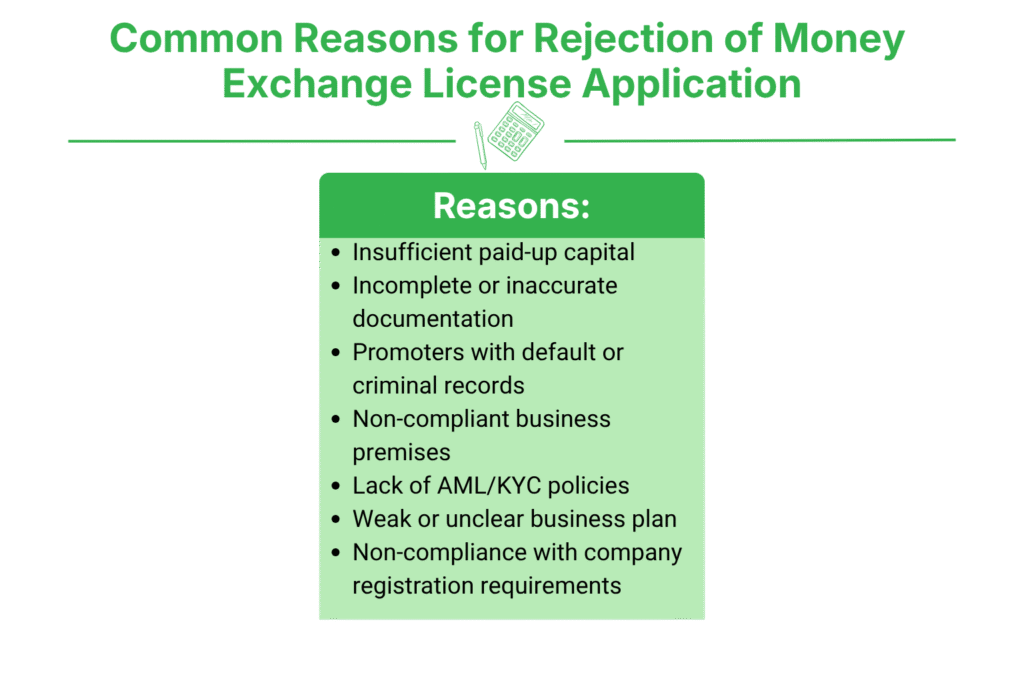
Nepal Rastra Bank may reject or put on hold an application for a money exchange license in Nepal due to the following reasons:
- Insufficient paid-up capital
- Inadequate or incomplete documentation
- Promoters or directors with financial default or criminal history
- Business premises not meeting prescribed standards
- Absence of AML/KYC policy framework
- Unclear or inconsistent business plan
- Non-compliance with Company Act registration requirements
FAQs
1. Who issues the money exchange license in Nepal?
Nepal Rastra Bank (NRB) issues the money exchange license in Nepal through its Foreign Exchange Management Department (FEMD). NRB is the sole regulatory authority for foreign exchange business in the country under the Foreign Exchange (Regulation) Act, 2019.
2. What is the minimum capital required for a money exchange license in Nepal?
For a Full-Fledged Money Changer (FFMC) license, the minimum paid-up capital is NPR 2 Crore. For a Restricted Money Changer (RMC) license, the minimum paid-up capital is NPR 50 Lakh as prescribed by NRB directives.
3. Can a foreign national obtain a money exchange license in Nepal?
Foreign nationals may participate as shareholders in a company applying for a money exchange license in Nepal, subject to applicable foreign investment regulations and NRB approval. The company must be registered under the Company Act, 2006.
4. How long does it take to obtain a money exchange license in Nepal?
The time to obtain a money exchange license in Nepal varies depending on document completeness and NRB’s verification process. Typically, the process takes several weeks to a few months after submission of a complete application with all required documents.
5. Is annual renewal required for a money exchange license in Nepal?
Yes, the money exchange license in Nepal requires annual renewal. The license holder must submit a renewal application with the prescribed fee, audited financial statements, and compliance documents to NRB before the license expiry date.
6. What law governs money exchange business in Nepal?
The Foreign Exchange (Regulation) Act, 2019 (2076 B.S.) and the Nepal Rastra Bank Act, 2002 (2058 B.S.) primarily govern the money exchange business in Nepal. NRB also issues specific directives and guidelines for money changers.
Conclusion
Obtaining a money exchange license in Nepal is a formal regulatory process overseen by Nepal Rastra Bank under the Foreign Exchange (Regulation) Act, 2019. The applicant must register a company, meet capital requirements, prepare complete documentation, and comply with NRB’s directives on AML/CFT, KYC, and reporting. Both Full-Fledged Money Changers and Restricted Money Changers must maintain ongoing compliance to retain their licenses. For official guidelines, application forms, and updated directives, visit the Nepal Rastra Bank official website.